NBA Odds: UK vs US Markets and Why the Differences Matter
 Available in US
Table of Contents
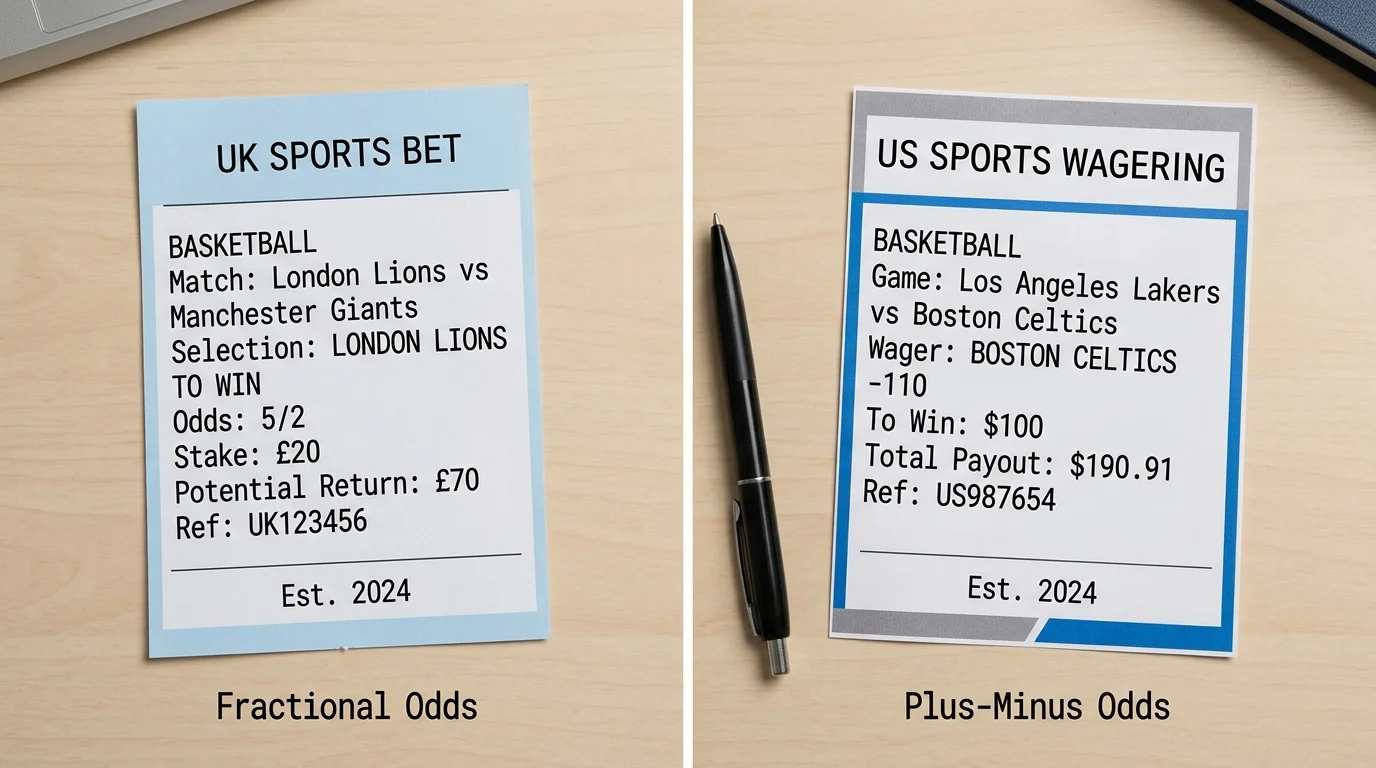
A few years ago I had a conversation with an American friend who bets NBA religiously. He mentioned laying -110 on a Celtics spread and I stared blankly for a moment before translating it in my head to 1.91 decimal. Same bet, same economics, completely different language. That interaction crystallised something I had been noticing for years: the UK and US NBA betting markets are not just different in format — they are different in structure, regulation, available markets, and the way odds are priced. Those differences create both confusion and opportunity for anyone willing to understand both sides.
Format Differences: More Than Just Presentation
The most visible difference is how odds are displayed. UK bookmakers default to fractional odds — 5/4, 11/8, 2/1 — or increasingly decimal odds like 2.25 or 1.85. American sportsbooks use the plus/minus system: -150 means you risk 150 to win 100, while +130 means you risk 100 to win 130. The underlying maths is identical, but the presentation affects how bettors perceive value, and that perception difference has real consequences.
Research into behavioural economics suggests that odds format influences betting decisions. American odds make the cost of backing a favourite more salient — seeing “-250” feels expensive in a way that “1.40” does not, even though they represent the same price. UK bettors using fractional odds may perceive “2/5” differently from “1.40” despite the mathematical equivalence. These framing effects are subtle but they shape which bets attract public money, which in turn affects where the value lies for informed bettors.
If you are a UK-based NBA bettor, I recommend becoming fluent in American odds as well. Most NBA analysis — tipster recommendations, line-movement tracking tools, sharp-money reports — originates from the US market and uses American format. If you cannot instinctively read -110 as 1.91 or +180 as 2.80, you will lose time in translation that could be spent on analysis. Every major UK sportsbook lets you toggle between formats in settings. Use this to train yourself until the conversion is automatic.
Market Availability: What the UK Gets and What It Does Not
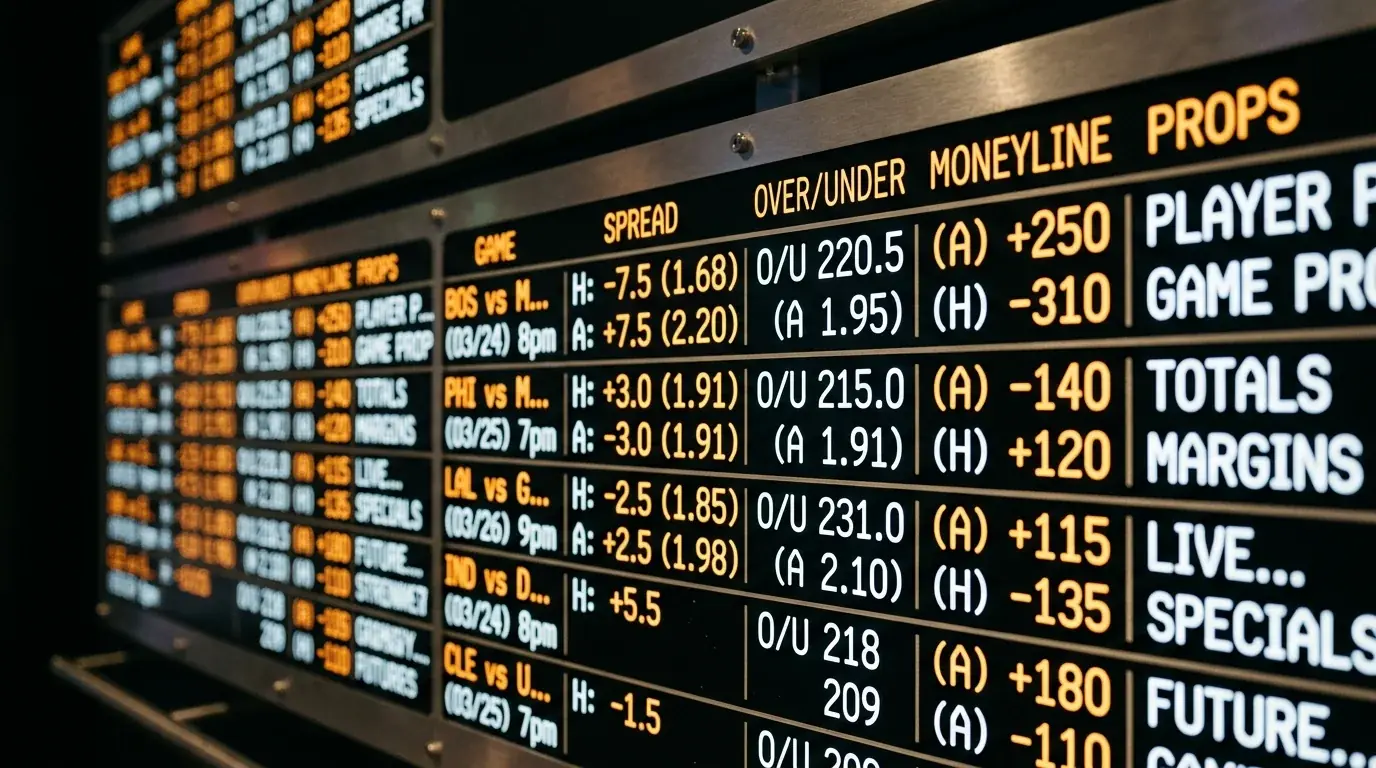
The US legal sports betting market generated a record $16.96 billion in revenue during 2025 — a 22.8% year-on-year increase — on total wagers of $166.94 billion. That volume means US sportsbooks can offer market depth that UK operators often cannot match for NBA specifically. FanDuel and DraftKings, which together control roughly 75% of the US handle, routinely list 300 or more individual markets per NBA game, including hyper-specific player props, team props, and quarter-by-quarter lines.
UK bookmakers typically offer fewer NBA-specific markets. The core offerings — moneyline, spread, totals, major player props, and same-game parlays — are available at most licensed UK platforms. But niche markets like alternate player props (will Player X record a double-double?), team-specific quarter totals, and exotic combination bets are often thinner or absent entirely. This is not a criticism of UK operators — it reflects the reality that NBA is not the primary sport for their customer base, and market depth follows demand.
The practical impact: if your NBA betting approach relies on deep player prop analysis or niche market exploitation, you may find the UK market limiting. The workaround is to use multiple UK sportsbooks to assemble the widest possible range of markets, rather than relying on a single platform. No single UK operator offers everything, but between four or five, you can cover most of the markets that matter for informed NBA betting.
Regulatory Differences and Their Impact on Odds
The regulatory gap between UK and US betting is significant and directly affects the odds you see on screen. The UK’s Remote Gaming Duty increased to 40% from April 2026, with a new General Betting Duty rate of 25% for online wagers following from April 2027. These taxes are paid by the operator, not the bettor — UK gambling winnings remain tax-free for punters — but the cost flows through to the odds.
Higher operator taxation compresses margins. When a bookmaker pays 40% tax on gross gaming revenue, they need wider margins per bet to maintain profitability. This means UK odds are structurally slightly worse than what US bettors see in competitive state-regulated markets where operator taxes range from 6% to 51% depending on the state, with most falling between 10% and 20%. The difference is not enormous on any single bet — perhaps 0.02 to 0.05 in decimal odds — but it compounds over hundreds of bets across a season.
Adam Silver, the NBA commissioner, has publicly stated his position on regulation: he believes there should be more federal oversight rather than the current state-by-state patchwork, and has emphasised the need to monitor promotional activity and advertising around betting. That regulatory uncertainty in the US means the competitive dynamics could shift — if federal legislation tightens the US market, the pricing gap between UK and US odds may narrow.
Line Movement Patterns: Two Markets, Two Rhythms
NBA lines move differently in the UK and US markets because the money flows at different times. US sportsbooks see the bulk of their NBA handle placed in the hours before tip-off and during live play. UK sportsbooks see a different pattern: some money comes in during the UK afternoon (when lines are first posted), a smaller wave in the late evening as games approach, and a trickle from dedicated night-owl bettors watching live.
This timing difference means UK lines sometimes lag behind US line movements. When sharp US money pushes a spread from -3.5 to -4.5 at a major American sportsbook, the equivalent line at a UK operator might take minutes or even hours to adjust. For UK bettors monitoring US line movements — through free tracking tools or Twitter accounts that report sharp action — this delay creates a window to grab odds that the US market has already deemed too generous.
The effect is most pronounced on player props and secondary markets, where UK operator pricing models rely more heavily on opening-line algorithms and less on real-time market correction from betting volume. Main-market spreads and totals adjust faster because they attract more UK money and more attention from the operator’s trading team. But a player prop that moved at DraftKings three hours ago might still be sitting at the old price on a UK platform. This is not theoretical — I exploit this timing gap regularly, and it is one of the most consistent edges available to UK-based NBA bettors who invest the time to monitor both markets.
Promotional Structures: UK Generosity vs US Volume
The promotional landscape differs substantially between the two markets. US sportsbooks compete aggressively on sign-up bonuses, often offering hundreds of dollars in bonus bets to new customers. UK operators offer welcome promotions as well, but the UKGC has tightened the rules around promotional terms — wagering requirements must be clearly stated, expiry periods cannot be unreasonably short, and misleading advertising is actively policed.
For existing customers, US sportsbooks tend to offer more frequent NBA-specific promotions: profit boosts on same-game parlays, insurance on losing bets, and odds boosts on marquee matchups. UK operators offer similar promotions but typically fewer of them and with tighter terms. The gap reflects both the competitive intensity of the US market — where operators are still spending heavily to acquire and retain customers — and the regulatory environment in the UK, which limits some promotional tactics that US operators use freely.
My approach is to use promotions tactically rather than chasing them. A free bet offer on an NBA game is only valuable if you would have been betting that game anyway. Chasing promotional odds boosts leads you into bets you have not properly analysed — and the operator knows this, which is exactly why they offer them.
Making the Cross-Market Difference Work for You
The UK bettor who understands the US market has a genuine advantage over one who does not. Not because the US market is inherently better, but because the information and line movement originating from a $166.94 billion annual handle provides signals that feed directly into the UK market — usually with a delay. Around 10% of UK adults participate in online sports betting, and the subset betting NBA is smaller still. The market is simply less efficient than its US counterpart.
What this means in practice: follow US line movements on free tracking tools. Note when US player props shift significantly and check whether the UK lines have adjusted. Read US-based NBA betting analysis — it is higher in volume and often sharper than UK-produced content because the market demand is larger. And above all, learn to read American odds fluently, because the analytical tools you need are built for that format.
The UK market has its own advantages too. Tax-free winnings are a structural benefit that US bettors in many states do not enjoy. UKGC regulation provides stronger consumer protection than some US state frameworks. And the fact that you are betting into a smaller, less efficient market means the opportunities for informed bettors are proportionally larger. The key is understanding both markets well enough to take the best from each.
Are UK NBA betting odds worse than US odds?
On average, yes — by a small margin. Higher UK operator taxation compresses odds slightly. The difference is typically 0.02 to 0.05 in decimal terms per bet. Over a season of heavy betting, this compounds noticeably, which is why line shopping across multiple UK platforms is important.
Can I use a US sportsbook from the UK?
No. US sportsbooks require you to be physically located within a state where sports betting is licensed. Geolocation technology verifies your position, and UK residents cannot legally access US-regulated sportsbooks. You are restricted to UKGC-licensed operators when betting from the United Kingdom.
Why do US NBA betting markets have more options than UK ones?
Volume drives depth. The US market handles vastly more NBA betting money than the UK, which incentivises US operators to offer hundreds of markets per game. UK operators allocate their modelling and trading resources proportionally, and since NBA is not the primary sport for UK bettors, the market depth reflects that.
Prepared by the nba Betting Online editorial staff.