NBA Betting Analysis
NBA Betting Online: a Data-Driven Guide for UK Punters
 Available in US
Table of Contents
- NBA Betting Online: a Data-Driven Guide for UK Punters
- The Numbers and Principles That Shape Every Section Below
- The NBA Betting Market in Numbers
- NBA Betting in the UK: Audience, Access, and Regulation
- Core NBA Betting Markets at a Glance
- Foundational Betting Principles That Move the Needle
- NBA Win-Rate Profit Calculator
- Why Live NBA Betting Dominates Online Revenue
- How to Evaluate a UK Sportsbook for NBA Wagers
- Reading NBA Odds: Fractional, Decimal, and American Formats
- Betting Integrity: What Recent NBA Scandals Mean for Punters
- NBA Viewership Growth and Its Link to Betting Volume
- Responsible Gambling: Tools, Data, and UK Resources
- Frequently Asked Questions About NBA Betting Online

NBA Betting Online: a Data-Driven Guide for UK Punters
Nine years ago, I placed my first NBA wager from a flat in East London — a second-half spread on a Spurs-Warriors regular-season game I was watching on a dodgy stream at half-one in the morning. I lost. I had no framework, no understanding of how fatigue compounds in the fourth quarter, and absolutely no idea that the line had already moved three points against me before tip-off. Since then, I have spent the better part of a decade studying every data set, academic paper, and market shift I could find to understand what actually separates profitable NBA bettors from the rest of us. This guide is the distillation of that work.
The UK sits in an unusual position in the NBA betting world. We have some of the most competitive sportsbooks on the planet, licensed under one of the strictest regulatory regimes in gambling, yet the average British punter has far less access to NBA-specific analysis than someone in New York or Las Vegas. Most UK-facing guides amount to little more than a list of bookmakers with welcome bonuses stuck to the side. That is not what you will find here.
What I have built is a data-first guide — every claim backed by market research, academic studies, or industry figures. You will find the numbers that the “top 10 sportsbook” articles never mention: how the basketball betting market grew to an estimated $8.7 billion globally, why NBA wagers alone account for roughly 60% of all basketball betting revenue worldwide, and what the UK’s own $3.3 billion sports betting market means for the odds you see on your screen tonight. This is not a sales pitch for any operator. It is an analyst’s framework for making smarter decisions with your bankroll.
Global Sports Betting Market
Approximately $125 billion in 2026, projected to reach $325.71 billion by 2035
Basketball Betting Market
$8.7 billion in 2024, forecast to hit $18.4 billion by 2033
UK Sports Betting GGY
Roughly GBP 2.48 billion per year as of early 2026
Whether you are placing your first NBA moneyline or refining a strategy you have run for years, this guide covers the full landscape: market sizing, UK regulation, core betting markets, research-backed strategy principles, live wagering, sportsbook evaluation, odds mechanics, integrity issues, and responsible gambling tools. Each section links to a deeper standalone article for those who want to go further. Read straight through or jump to the section that matters most right now.
Let’s start with the market that makes all of this possible.
The Numbers and Principles That Shape Every Section Below
- The basketball betting market is valued at $8.7 billion globally, with NBA wagers generating roughly 60% of that revenue.
- UK Remote Gaming Duty nearly doubled to 40% in April 2026 — expect tighter sportsbook margins and prioritise line shopping.
- Live betting accounts for over 62% of online sports betting revenue; the NBA’s structure makes it ideal for in-play wagering.
- Professional handicappers hit NBA spreads at 47-49%. Break-even is 52.4%. Bankroll discipline beats any prediction method.
- Set deposit limits before the season. Use the responsible gambling tools built into every UKGC-licensed platform.
The NBA Betting Market in Numbers
I remember the moment NBA betting stopped feeling like a niche hobby to me. It was 2022, and I was looking at a DataHorizon report that pegged the global basketball betting market at a figure I had to read twice. The numbers have only accelerated since. The global sports betting industry sits at approximately $125 billion in 2026, with projections pushing it toward $325.71 billion by 2035 — a compound annual growth rate of 11.24%. Basketball’s slice of that pie is not small: the basketball wagering market was valued at $8.7 billion in 2024 and is expected to more than double to $18.4 billion by 2033, growing at an 8.7% clip year after year.
What makes the NBA singular within basketball betting is its sheer dominance. NBA wagers generate roughly 60% of all global basketball betting revenue. Not college basketball, not European leagues, not the fast-growing markets in the Philippines or South Korea — the NBA alone accounts for the majority. That concentration of handle creates deep, liquid markets where odds are sharp and opportunities for the informed bettor are real, if harder to find than in less efficient leagues.
The NBA ecosystem — media rights, merchandise, sponsorships, and betting — is valued at $13.92 billion in 2026, with projections reaching $20.04 billion by 2031. The league is not just a sport; it is a financial engine that powers an enormous secondary market in wagering.

The American Gaming Association reported that US sports betting hit a record $16.96 billion in revenue during 2025 — a 22.8% jump — with total handle reaching $166.94 billion. Bill Miller, the AGA’s president, noted that legal commercial gaming delivered exceptional results for consumers, operators, and the communities they serve. That US boom matters to UK punters because it drives competition, product innovation, and market depth that spills across the Atlantic. When American operators invest billions in odds modelling and live betting infrastructure, UK platforms sharing parent companies or technology stacks benefit directly.
Online channels accounted for roughly 75% of worldwide sports betting revenue in 2025. The tools, the data, and the speed advantages that define modern NBA betting are all digital. If you are still thinking of sports betting as something that happens in a shop on a Saturday afternoon, the market has moved on without you.
NBA Share of Basketball Betting
~60% of global basketball betting revenue
Online Share of Sports Betting
~75% of worldwide revenue in 2025
US Sports Betting Revenue 2025
$16.96 billion (+22.8% year-over-year)
Basketball commands 15-18% of global bookmaker activity, and at certain US operators that figure climbs to 31% of total wagering volume. The NBA regular season runs from October to April with playoffs through June — an eight-month window of daily action that creates consistent volume no other basketball league can match. The 82-game schedule per team means roughly 1,230 regular-season games each year, each carrying its own spread, total, moneyline, and dozens of derivative markets.
These numbers determine the liquidity of the markets you bet into, the speed at which lines move, and the margins your sportsbook takes. A bettor who understands market scale understands why certain games attract sharp money within minutes of the opening line, and why others sit untouched until an hour before tip-off.
NBA Betting in the UK: Audience, Access, and Regulation
Last January, I ran an informal poll among the punters I advise: how many NBA games had they watched live that week? The median answer was two. Five years ago it would have been zero. The UK’s relationship with the NBA has changed fundamentally, and the betting market has followed. Sky Sports broadcasts 170 NBA games per season to British audiences, and with tip-off times for East Coast games landing around midnight or 12:30 AM UK time, a dedicated late-night audience has built around the league in a way that felt impossible a decade ago.
The UK sports betting market generates approximately GBP 2.48 billion in gross gambling yield per year — around $3.3 billion — making it one of the largest regulated markets in the world. About 10% of British adults participate in online sports betting, with a sharp gender split: 15% of men versus 4% of women place sports wagers. Among the 18-24 demographic, 76% of those who bet do so on mobile devices. These are not casual figures. They describe a market that is mature, mobile-first, and increasingly interested in sports beyond the Premier League.
UK Gambling Commission Licensing — Every sportsbook legally operating in the UK holds a licence from the UKGC. This guarantees segregated customer funds, dispute resolution through an approved Alternative Dispute Resolution provider, mandatory responsible gambling tools, and compliance with advertising standards. A UKGC licence does not guarantee good odds or deep NBA markets, but it does mean you have legal recourse if something goes wrong.
Roughly 290 million online bets on real events are placed every month across UK platforms. That volume creates a competitive ecosystem where operators fight for market share through odds quality, market range, and promotional offers. For NBA bettors, this competition means you can find meaningfully different prices on the same game across three or four UK-licensed sportsbooks — making sportsbook evaluation one of the highest-value activities in your routine.
The regulatory picture shifted sharply in 2026. Remote Gaming Duty — the tax operators pay on online gambling revenue — jumped from 21% to 40% on 1 April 2026. A new General Betting Duty rate of 25% for online bets follows on 1 April 2027. These are enormous increases. HM Treasury estimates the changes will bring in GBP 810 million in 2026/27, rising to GBP 1.16 billion by 2030/31. Deloitte’s tax team noted bluntly that the increase in online rates will have a large impact on regulated operators offering online betting and gaming to UK consumers.
Remote Gaming Duty: 21% to 40% — The near-doubling of the operator tax rate is the single biggest regulatory shift for UK sports betting in over a decade. Operators will absorb some of that cost, but margins on NBA markets — already thinner than football markets at most UK sportsbooks — are likely to tighten further. As a punter, this means odds quality may erode, making line shopping and value identification even more critical than before.
Tim Miller, the Gambling Commission’s executive director, framed the Commission’s priorities at a recent industry conference: the commitment to making gambling safer, fairer, and crime-free continues, alongside an aspiration to collaborate with everyone who shares those goals. That language matters because it signals sustained enforcement rather than a single regulatory push. In 2025-26 alone, the Commission issued 741 cease-and-desist notices to unlicensed gambling advertisers and operators — a number that tells you the regulator is actively policing the boundaries of the market.
For UK-based NBA bettors, the practical implications are straightforward. Stick with UKGC-licensed operators. Expect the duty increases to nudge margins upward on some markets. And take advantage of the fact that you are betting in one of the most competitive, well-regulated environments in global sports gambling — where responsible gambling tools are built into every licensed platform by law.
Core NBA Betting Markets at a Glance
The first time I opened a sportsbook’s NBA section in 2017, I counted nine different markets on a single regular-season game. Last week I counted forty-three on a Celtics-Knicks matchup. The expansion of available markets has been one of the most significant changes in NBA betting over the past decade, and it is driven by two forces: demand from increasingly sophisticated bettors and the technology that allows sportsbooks to price exotic markets in real time. Basketball accounts for 15-18% of global bookmaker activity, and that handle is spread across far more market types than most beginners realise.
Here is a framework for the core market categories you will encounter at any UK-licensed sportsbook. Each gets its own deep-dive in the dedicated NBA betting markets explained guide, but understanding the landscape before you specialise is essential.
Moneyline (Match Result)
Pick the team that wins. No spread, no margin. NBA games cannot draw, so two outcomes only. The favourite carries shorter odds, the underdog offers a higher return. Suited for bettors with a strong view on the outright winner.
Point Spread (Handicap)
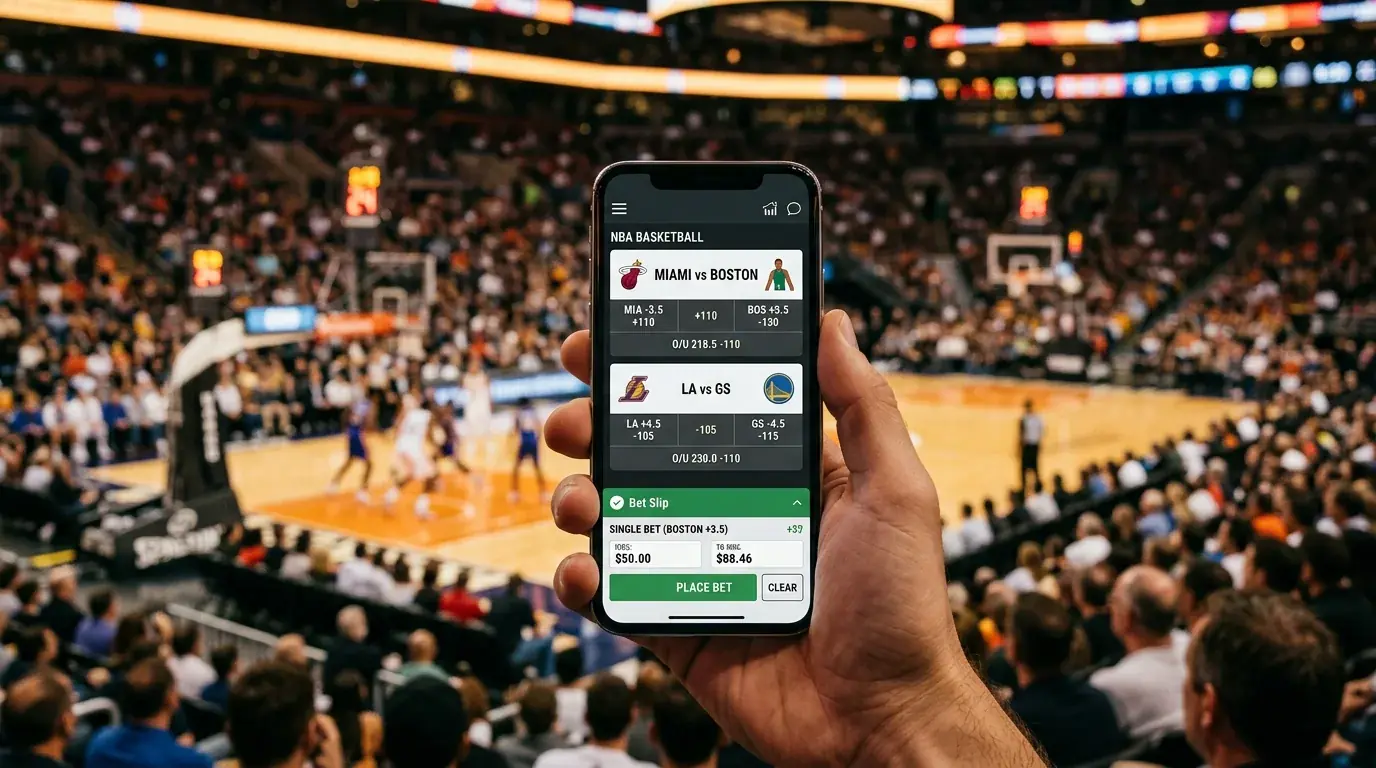
The most popular NBA market by volume. The sportsbook sets a points handicap — say, -6.5 for the favourite — and they must win by more than that margin for the bet to land. Spreads equalise the market and attract the sharpest money. Line movement before tip-off tells you where informed bettors are positioned.
Totals (Over/Under)
A wager on the combined final score. The sportsbook sets a line — for example, 218.5 — and you bet over or under. Heavily influenced by pace, defensive rating, and rest patterns. A way to bet on a game’s character without picking a side.
Player Props
Bets on individual performance: points, rebounds, assists, three-pointers, and combinations like double-doubles. Player props let you leverage matchup-specific knowledge — a centre facing a weak interior defence, a guard whose usage spikes when a teammate is injured.
Futures and Outrights
Season-long bets: championship winner, MVP, conference champions, win totals. Futures tie up your stake for weeks or months but offer the largest returns. Timing matters — odds shift after every significant injury, trade, or streak.
Bet Builder (Same-Game Parlay)
Combines multiple selections from the same game into one wager. The correlation between legs affects the true odds, and most sportsbooks price that correlation into the return — not always in your favour.
Accumulator (Parlay) — A multi-selection bet where all legs must win for the wager to pay out. In UK betting terminology, this is an “acca.” Each added leg multiplies the potential return but also multiplies the probability of losing. The mathematics work heavily against accumulators in the long run, though they remain the most popular bet type by volume at many sportsbooks.
Handicap vs. Spread — These terms are used interchangeably in NBA betting. UK sportsbooks often label the market as “handicap,” while American platforms say “spread.” The mechanics are identical: one team receives a points advantage or disadvantage that is applied to the final score for settlement purposes.
Beyond these core categories sit niche markets — winning margin bands, first basket scorer, quarter and half-time lines, race to a certain score, and special combination markets that vary by operator. The breadth of choice is an advantage for bettors who develop expertise in a specific market type, because sportsbooks cannot price every derivative market with the same precision they apply to the headline spread or total. That imprecision is where edges live.
Foundational Betting Principles That Move the Needle
In my third year of tracking NBA wagers, I realised something uncomfortable: my win rate on point spreads was 49.1%. I was watching more basketball than anyone I knew, spending hours on matchup research, and still losing money. The problem was not my game analysis — it was everything around it. Bankroll discipline, value identification, and a realistic understanding of what “good” looks like in this market. Professional NBA handicappers, the ones who do this full-time and publish verified records, show a success rate of about 47% on spread picks and 49% on over/under. The break-even threshold at standard -110 juice is 52.4%. Those numbers should recalibrate your expectations immediately.
NBA Win-Rate Profit Calculator
At standard -110 juice you need to win 52.4% of bets just to break even – and pros hit spreads at 47-49%. Enter your win rate, price and volume to see whether your record actually makes money over a season, or quietly loses it.
How this works: the break-even win rate is simply the implied probability of your price – 1 ÷ decimal odds. At 1.91 (the -110 standard) that is 52.4%, which is why a 50% record loses money: the juice is the gap. Long-run profit = bets × [win rate × profit-per-win − loss rate × stake], where profit-per-win = stake × (odds − 1). ROI is that profit divided by everything you staked. The headline lesson from the data is uncomfortable: professional NBA handicappers hit spreads at about 47-49% and over/unders around 49%, all below the 52.4% line – which is why win rate is a vanity metric and closing-line value, line shopping and flat staking are what actually separate winners from losers. A single extra half-point of price, or a book at 1.95 instead of 1.91, drops your break-even and turns a losing record into a winning one without you picking a single extra game correctly. This models a constant win rate and flat stakes; real results swing on variance around the average. Not financial advice. 18+ – GamStop and BeGambleAware are protection routes; National Gambling Helpline 0808 8020 133.
The full breakdown of each strategy lives in the NBA betting strategy guide, but the principles here are the ones I consider non-negotiable — the foundation without which no specific tactic survives contact with a real bankroll.
Do
- Define your unit size as 1-2% of your total bankroll before the season starts, and do not adjust it upward after a winning streak.
- Track every wager — market, odds, stake, result, closing line — in a spreadsheet. Without data on your own performance, you are guessing about whether your approach works.
- Shop lines across at least three UK sportsbooks for every NBA bet. A half-point of spread or 0.05 in decimal odds compounds over hundreds of wagers into a significant difference.
- Focus on closing line value as your primary performance metric. If you consistently beat the closing line, you are likely a long-term winner even during losing streaks.
Don’t
- Chase losses by increasing your stake after a bad night. The maths does not care about your emotions, and the market does not reward urgency.
- Bet every game on the schedule. The NBA plays up to 15 games on some nights. Your edge, if you have one, exists in a small subset of those games — the ones where your analysis diverges meaningfully from the market price.
- Ignore rest and schedule patterns. A team on the second night of a back-to-back, travelling across time zones, is a different proposition from the same team with two days off at home.
- Treat accumulators as a strategy. They are entertainment with a built-in mathematical headwind.
One data point reshaped how I approach NBA wagers more than any other. A study examining 2,295 NBA games over ten years found that only 19% of matches remain within a 10-point margin heading into the fourth quarter. Over four-fifths of NBA games are effectively decided — at least in terms of competitive tension — before the final period. If your strategy relies on late-game drama to cover spreads, you are betting against the structural reality of how NBA games unfold. Research into shooting efficiency tells a complementary story: accuracy declines as games progress, with a significant effect size of -1.27 between the first and fourth quarters. Fatigue is measurable, and it changes the character of scoring in ways that directly affect totals and quarter-specific markets.
Applying the Break-Even Threshold
Suppose you wager on NBA spreads at standard fractional odds of 10/11 (decimal 1.91). For every GBP 11 you stake, a win returns GBP 10 in profit plus your stake. Over 100 bets at GBP 11 each (GBP 1,100 total outlay), you need to win 52.4 bets to break even — that is, 52.4% of the time. At 55% win rate, your profit is roughly GBP 65 over those 100 bets. At 50%, you lose GBP 50. The margin between profit and loss is razor-thin, which is precisely why bankroll management and line shopping matter more than any single game prediction.

Adam Silver, the NBA commissioner, has noted that fans often win on the team result but lose because a player fell short of a props threshold — scoring 25 when the line was 28. The sportsbook knows recreational bettors gravitate toward overs on star players and prices accordingly. The edge, when it exists, is more often on the under side of player props — particularly for players in heavy-minute roles late in the season.
Why Live NBA Betting Dominates Online Revenue
I was sitting in a pub in Shoreditch during the 2023 playoffs when the bloke next to me pulled out his phone and placed a live bet on a fourth-quarter spread — mid-possession. He tapped twice, confirmed the stake, and went back to his pint. That casualness is the product of a massive infrastructure shift. Live, in-play wagering accounted for 62.35% of all online sports betting revenue in 2025, and that share is growing at a compound rate of 13.62% annually. The NBA, with its constant scoring, frequent stoppages, and quarter-by-quarter structure, is one of the sports most suited to live betting — and UK punters are leaning into it heavily.
What makes NBA live betting distinct from pre-match wagering is the speed of information. Odds move on every possession. A team goes on a 10-0 run, and the live spread shifts by four or five points in under two minutes. An injury in the third quarter rewrites the moneyline within seconds. The sportsbook’s algorithms are fast, but they are not infallible — particularly during chaotic sequences like a flurry of turnovers or a technical foul that changes momentum. The best live bettors I know exploit those windows by watching the game and acting on what they see before the algorithm fully prices it in.
Mobile devices now handle 78% of all online wagers, and roughly 80% of bettors use their phones as their primary betting tool. For live NBA betting, mobile is not just convenient — it is the only realistic way to act on odds that change every few seconds. Speed, app stability, and one-tap bet placement have become genuine competitive advantages.
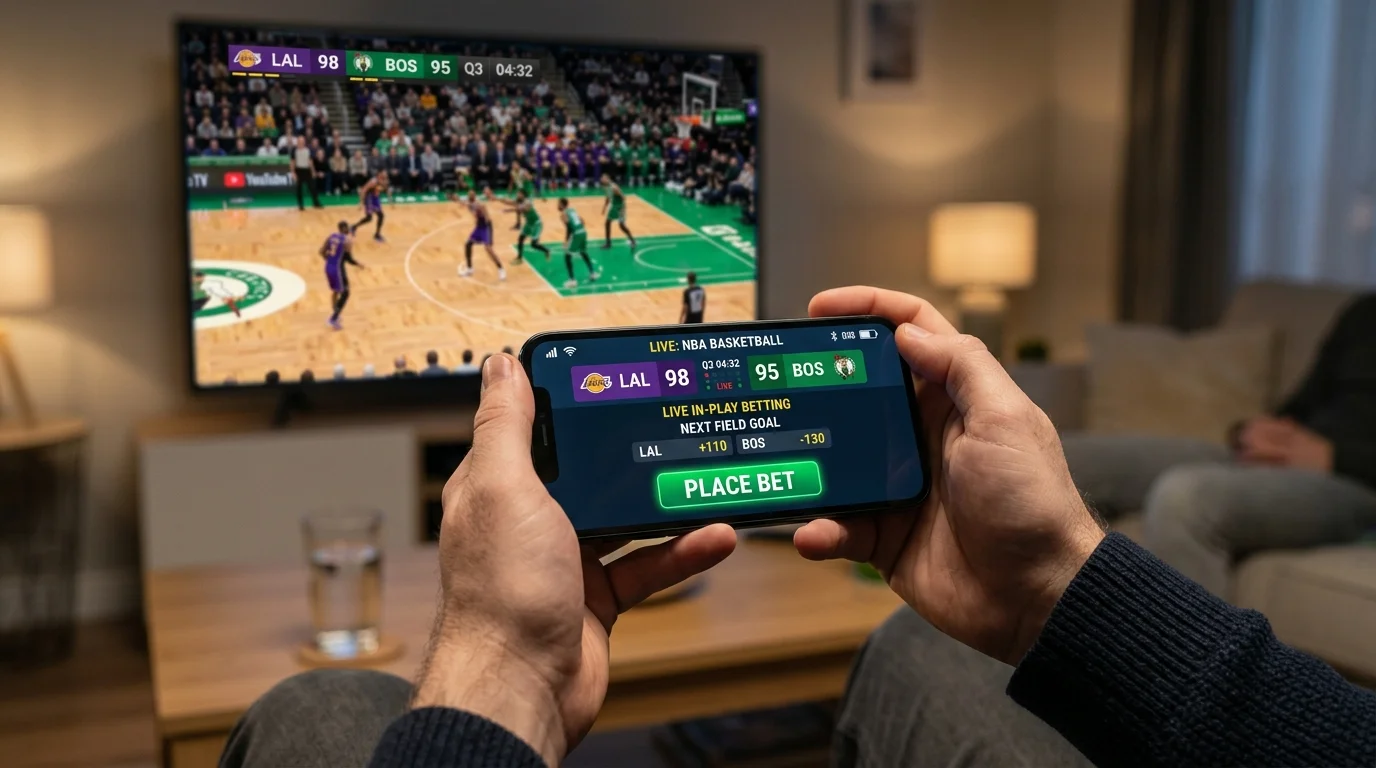
The full mechanics of in-play wagering — timing strategies around quarter breaks and timeouts, streaming options, cash-out tools, and the discipline required to avoid impulsive bets in a fast-moving environment — are covered in the NBA live betting guide. Here, the key insight is structural: live betting now generates more revenue than pre-match for the industry as a whole, and that shift has changed how sportsbooks allocate their pricing resources. The sharpest odds during an NBA game are often the pre-match lines, because that is where the sharpest bettors have already acted. Once the game goes live, the margins tend to widen — which means the live bettor needs to be more selective and more patient than the pre-match bettor.
Among the 18-24 demographic in the UK, 76% of those who bet use mobile devices. That age group is also the fastest-growing segment of NBA viewership. The overlap is not coincidental: the NBA’s product — fast, visual, stat-rich, and globally accessible via streaming — maps perfectly onto the live-betting experience that mobile platforms are built to deliver.
Live betting demands a sportsbook that can keep up. The next section turns to what separates a competent NBA platform from a liability.
How to Evaluate a UK Sportsbook for NBA Wagers
A punter I mentor switched sportsbooks last season solely because his original platform did not offer first-basket-scorer markets on NBA games. That single missing market was not the real problem — it was a symptom of shallow NBA coverage that also showed up in slow live odds updates and a limited player props menu. Choosing where you bet is not a trivial decision, and the criteria that matter for NBA wagering are different from what you would prioritise for Premier League or horse racing.
The detailed sportsbook evaluation framework lives in the NBA betting sites UK guide, but let me lay out the principles I use when assessing a platform for basketball.
Start with market depth. A sportsbook that lists moneyline, spread, and totals on an NBA game is doing the bare minimum. You want player props across at least five categories (points, rebounds, assists, three-pointers, combinations), quarter and half-time lines, bet builder functionality, and futures markets that extend beyond the championship winner to include MVP, Rookie of the Year, and conference odds. Depth of markets is a proxy for how seriously the operator takes NBA coverage.
Odds quality matters more than any welcome bonus. A sportsbook offering you a GBP 10 free bet but consistently pricing NBA spreads 0.03 worse in decimal odds than a competitor will cost you far more over a season. The largest UK-facing operator group reported group revenue of $15.91 billion for 2025, with EBITDA up 21% to $2.85 billion. Those margins come from the overround built into every market. Your job is to find the platforms that compress that overround most aggressively on NBA lines.
Deep NBA Coverage
40+ markets per game, player props across multiple stat categories, live in-play with sub-5-second odds refresh, bet builder with NBA support, futures for all major awards, quarter and half-time lines, first basket scorer.
Shallow NBA Coverage
Moneyline, spread, and totals only. Limited or no player props. Bet builder unavailable for NBA. Futures restricted to championship winner. No quarter or period markets. Live odds update slowly or freeze during fast-paced sequences.
Beyond markets and odds, consider the everyday infrastructure. The overwhelming majority of UK online betting is on mobile. An NBA betting app that crashes during a live fourth quarter or takes four taps to confirm a wager is costing you money in missed windows. Test the app with a small stake during a regular-season game before committing your bankroll to any platform.
Sportsbook Evaluation Checklist for NBA
- Holds a current UK Gambling Commission licence (non-negotiable).
- Offers at least 30 markets per NBA regular-season game.
- Provides player props across points, rebounds, assists, and three-pointers as a minimum.
- Supports bet builder / same-game parlay for NBA events.
- Publishes NBA futures for championship, MVP, and conference winners.
- Delivers live in-play odds that refresh within seconds during gameplay.
- Offers at least one NBA live streaming or live data visualisation option.
- Processes withdrawals within 24 hours for at least one payment method.
- Provides deposit limits, time-out, and self-exclusion tools accessible from the account settings.
Payment speed is an underrated factor. If a sportsbook takes 72 hours to process a withdrawal, your bankroll is less liquid, and your ability to move funds between platforms for line shopping is constrained. The best operators for NBA betting in the UK process e-wallet withdrawals within a few hours. That speed is not a luxury — it is a functional requirement for a bettor who shops lines across multiple accounts.
Reading NBA Odds: Fractional, Decimal, and American Formats
Every week I get at least one message from a UK punter asking why the NBA odds they see on an American podcast do not match what their sportsbook displays. The answer is format, not fraud. UK platforms default to fractional odds, European-facing sites use decimal, and American media quotes plus and minus lines. All three express the same underlying probability — they just speak different languages. Understanding the translation between them is a basic literacy requirement for anyone betting on a global sport through a UK platform.
The complete breakdown of each format, conversion formulas, and implied probability calculations is in the NBA betting odds explained guide. Here I will walk through the essentials.
The Same Bet in Three Formats
Suppose a team is priced as a moderate favourite in an NBA game. Here is how that price appears across formats:
| Format | Odds | What It Means |
|---|---|---|
| Fractional (UK default) | 4/6 | For every GBP 6 staked, you win GBP 4 in profit. Total return: GBP 10. |
| Decimal | 1.67 | Multiply your stake by 1.67 for total return. GBP 10 stake returns GBP 16.70. |
| American | -150 | You must stake $150 to win $100 in profit. The minus sign indicates a favourite. |
All three represent the same implied probability: approximately 60%.
Fractional odds are the UK standard, and they express the profit relative to your stake. A price of 5/2 means GBP 5 profit for every GBP 2 wagered. Decimal odds fold the stake into the return, making payout calculation a single multiplication. American odds centre around a $100 unit — negative numbers tell you how much to stake for $100 profit (favourites), positive numbers tell you how much $100 wins (underdogs). Each has its practical use. I work in decimal for quick mental arithmetic but switch to fractional when comparing UK sportsbook prices side by side, because that is how most UK platforms display their default boards.
The concept that ties all three formats together is implied probability — the percentage chance of an outcome that the odds represent before the sportsbook’s margin is applied. A bet priced at 1.91 decimal has an implied probability of 52.4%. If your analysis gives the outcome a 56% chance, the gap is your theoretical edge. The sportsbook’s margin — called overround or vig — is the difference between the sum of implied probabilities on all outcomes and 100%. On a two-way NBA moneyline, if the favourite implies 60% and the underdog 45%, the overround is 5%. That is the operator’s theoretical profit and the cost of participation every bettor pays. Overrounds vary by operator, market type, and game — shopping for the lowest overround on your specific bet is one of the simplest ways to improve long-term results.
One last point on odds mechanics. NBA lines move. They move because of injury reports, because of volume (lots of money on one side), and because sharp bettors — the professionals whose action sportsbooks respect — push the line in a direction the book must follow. The opening line on a Tuesday morning may look nothing like the closing line at tip-off. Learning to read that movement is a skill that takes time, and it is covered thoroughly in the odds guide linked above.
Betting Integrity: What Recent NBA Scandals Mean for Punters
When the news broke about Jontay Porter’s ban in 2024, I got a string of messages from punters asking whether the whole system was rigged. It is a fair reaction — an active NBA player sharing inside information that ended up shaping prop bets is exactly the kind of scandal that erodes trust. But the reality is more nuanced than “the league is corrupt,” and understanding the integrity landscape actually helps you become a sharper bettor.
The NBA has faced several gambling-related cases in recent years, including investigations into Terry Rozier and Chauncey Billups alongside the Porter situation. A US Attorney described one case as an insider sports betting conspiracy that exploited confidential information about NBA athletes and teams. These were not abstract violations — they involved real bets on real markets, some of which UK punters had access to through licensed sportsbooks.
Integrity Is Not Just a League Problem — When player-level manipulation occurs, it most directly affects prop markets and, in some cases, totals. The bettor who placed an over on a player’s points total without knowing that the player intended to exit the game early was not just unlucky — they were operating in a compromised market. Integrity breaches are a form of information asymmetry, and recognising which markets are most exposed to that asymmetry is part of risk management.
Adam Silver has been more candid about these challenges than any major sports commissioner in recent memory. He acknowledged that the league had a pit in the stomach when the scandals emerged, calling the situation very upsetting. But he also described the learning process: working with the betting companies, putting in place additional controls to prevent manipulation. The NBA now monitors betting patterns in partnership with sportsbook operators and data integrity firms, and the league’s rules on player gambling have been tightened significantly. Players, team staff, and their associates face lifetime bans for betting on NBA games.
For UK punters, there are three practical takeaways. First, prop markets on lower-profile players are the most vulnerable to manipulation — star players have too much to lose, and their performance is too visible to manipulate without detection. Second, sudden, unexplained line movements on props or totals should be treated with caution, not as an opportunity. If a player’s points line drops sharply without any public injury news, something may be happening that you cannot see. Third, the overall integrity of the NBA’s core markets — spreads and moneylines — remains high. The sheer volume of money, the depth of monitoring, and the career consequences for manipulation make game-outcome fixing extraordinarily difficult at the NBA level.
Silver also raised a broader concern: the volume of promotion and advertising around gambling needs more regulation, and he has advocated for federal rather than state-by-state legislation in the US. That position reflects a league that sees betting as a permanent part of its business model — not something to push underground, but something requiring robust guardrails. For UK bettors operating under the UKGC framework, those guardrails are already in place.
NBA Viewership Growth and Its Link to Betting Volume
There is a number I keep coming back to when people ask me why NBA betting has grown so fast in the UK: 170 million. That is how many people in the United States watched NBA games during the 2025-26 season across ABC, ESPN, Amazon Prime Video, NBC, Peacock, and NBA TV — a figure the league reported as a 24-year high, up 86% year-over-year. Globally, more than 1.3 billion hours of live NBA content were consumed on linear and streaming platforms, a 93% increase. Those are not just television statistics. They are the fuel line for a betting market that grows in direct proportion to the audience watching the games.
US NBA Viewership 2025-26
170 million viewers — highest in 24 years, +86% year-over-year
Global Live Hours Consumed
1.3 billion+ hours on linear and streaming platforms, +93% year-over-year
NBA Media Rights Deal
$77 billion with Disney, NBC, and Amazon for 2025-2036
The $77 billion media rights deal signed with Disney, NBC, and Amazon for 2025-2036 is the economic backbone of this growth. It guarantees the NBA will be distributed across the most-watched platforms in the US and internationally for the next decade, and it locks in a level of production investment — camera angles, real-time stats overlays, in-broadcast betting integrations — that makes the viewing experience increasingly useful for live bettors. The NBA Finals in 2025 drew 32.4 million viewers across all platforms, with 41% of the audience watching from outside the United States and Canada.
For UK punters specifically, the connection between viewership and betting is mediated by access. Sky Sports carries 170 NBA games per season, and NBA League Pass has 12.4 million paid subscribers globally. The international audience is not a secondary consideration for the league — over 70% of the NBA’s social media followers are outside the US, and half the total audience is younger than 25. That demographic skew matters because younger viewers are more likely to bet, more likely to bet on their phones, and more likely to engage with the real-time data streams that make live NBA wagering viable.
The bottom line is this: as the NBA’s audience grows, so does the liquidity and depth of its betting markets. More viewers mean more bettors. More bettors mean tighter spreads, faster line movement, and more market efficiency — which is both a challenge and a validation. The NBA is not a niche betting product any more. It is a mainstream market with global depth, and UK punters who treat it as an afterthought to their football betting are leaving value unexplored.
Responsible Gambling: Tools, Data, and UK Resources
I have written this guide with the assumption that you are betting with money you can afford to lose. That is not a throwaway line — it is the single most important sentence in this entire article. The NBA offers an eight-month season of daily games, and the rhythm of it can make wagering feel like a default activity rather than a deliberate choice. About 10% of UK adults participate in online sports betting, and while the vast majority do so without experiencing harm, the ones who cross the line often do not realise it until the damage is significant.
Baroness Twycross, the UK Minister for Gambling, put the challenge clearly: she wants to see a safer, more responsible gambling industry, acknowledging that it is in everyone’s interests to do better for customers who could be vulnerable to gambling harm. That is not political rhetoric — it reflects a regulatory direction that is embedding responsible gambling tools into the infrastructure of every licensed platform.
UK Responsible Gambling Tools — Every UKGC-licensed sportsbook is required to offer deposit limits (daily, weekly, monthly), session time limits and reality checks, cooling-off periods and temporary time-outs, self-exclusion for a minimum of six months, and access to account activity statements. GAMSTOP provides a single self-exclusion registration that covers all UKGC-licensed online gambling operators. GambleAware offers free advice, information, and support. The NHS National Gambling Treatment Service provides clinical treatment at no cost.
The data on UK betting behaviour tells a specific story. 15% of men and 4% of women make sports wagers, with the heaviest concentration in the 18-34 age range. 95% of online gambling activity happens from home. The removal of physical and social friction — no need to walk to a betting shop, no queue, no interaction with another person — means the barriers between impulse and action are essentially zero on a mobile device. That convenience is the same feature that makes live NBA betting so appealing, and it is also the feature that makes self-regulation harder.
I set a weekly deposit limit on every sportsbook account I use. Not because I have a problem, but because limits remove the decision from the emotional moment. When I have had a bad night and the late West Coast games are still tipping off, the limit prevents me from making the chase bet that I know, intellectually, is a losing play. If you take one piece of advice from this section, let it be that: set your limits before the season starts, and do not increase them mid-season. The tools exist. Using them is not a sign of weakness — it is the same risk management discipline that makes you a better bettor in every other respect.
Frequently Asked Questions About NBA Betting Online
Is NBA betting legal in the UK?
Yes. Betting on NBA games is fully legal through any sportsbook licensed by the UK Gambling Commission. The Gambling Act 2005 permits licensed operators to offer markets on international sporting events, including all NBA competitions. Your winnings are not subject to income tax. The key requirement is using a UKGC-licensed operator — unlicensed offshore sites offer no regulatory recourse and no guaranteed fund segregation.
What are the most popular NBA betting markets?
Point spread (handicap), totals (over/under), and moneyline (match result) are the three highest-volume NBA markets at UK sportsbooks. Player props — bets on individual statistics like points, rebounds, and assists — have grown rapidly and now represent a significant share of handle. Futures markets and bet builder combinations round out the core offerings.
How do NBA point spreads work?
A point spread assigns a handicap to the favoured team. If a team is listed at -6.5, they must win by 7 or more points for a spread bet to pay out. Backing the underdog at +6.5 means they can lose by up to 6 points and your bet still wins. The half-point eliminates the possibility of a push. Spreads move in response to injury news, rest patterns, and sharp bettor activity between opening and tip-off.
Does overtime count in NBA bets?
For most markets, yes. Moneyline, point spread, and totals are settled on the final score including overtime. The exception is period-specific markets: first-quarter, half-time, and quarter bets settle on the score at the end of that period regardless of overtime. Player props also include overtime statistics unless the sportsbook’s rules state otherwise — check settlement terms before placing your wager.
What is the best strategy for NBA betting?
No single strategy guarantees profit. The principles that separate consistent bettors from recreational ones are bankroll management (1-2% of total bankroll per bet), line shopping across multiple sportsbooks, and tracking closing line value as a performance metric rather than short-term win rate. Professional handicappers operate at 47-49% on spreads; the break-even threshold is 52.4%. Selective wagering — betting only when your analysis diverges meaningfully from the market price — outperforms high-volume approaches.
When is the best time to place NBA bets?
It depends on your edge. Betting early captures value before the market adjusts if your matchup analysis is strong. Waiting until closer to tip-off gives you late-breaking injury reports and lineup confirmations. For UK punters, tip-off is typically between 11 PM and 3:30 AM. The principle: bet when you have an information advantage relative to the market, not at a fixed time.
How do I read NBA betting odds in the UK?
UK sportsbooks default to fractional odds. A price of 5/2 means GBP 5 profit for every GBP 2 staked. Decimal odds (e.g., 3.50) show total return as a multiplier of your stake. American odds use plus/minus notation: -150 means staking GBP 150 to win GBP 100, while +200 means GBP 100 wins GBP 200. All three formats express the same probability. Most UK platforms let you toggle between formats in your account settings.
Created by the ”nba Betting Online” editorial team.