NBA Betting Markets Explained: Every Wager Type UK Sportsbooks Offer
 Available in US
Table of Contents
- NBA Betting Markets Explained: Every Wager Type UK Sportsbooks Offer
- Moneyline (Match Result)
- Point Spread (Handicap) Betting
- Over/Under (Totals)
- Accumulators and Multi-Bet Options
- Bet Builder and Same-Game Combinations
- Futures and Outright Markets
- Niche Markets: Winning Margin, Quarter Bets, and First Basket
- Choosing the Right Market for Your Betting Style
- Frequently Asked Questions

NBA Betting Markets Explained: Every Wager Type UK Sportsbooks Offer
I placed my first NBA bet in 2017 on a random Tuesday night Spurs-Grizzlies game, and I got it wrong in the most instructive way possible — I picked the right winner but had no idea what market I was actually betting on. The sportsbook had defaulted to a -6.5 point spread, and my “winning” team covered nothing. That confusion cost me a tenner and taught me a lesson worth thousands: understanding what you are wagering on matters more than understanding who will win.
Nine years later, I still see the same confusion in my inbox every week. UK punters who follow the NBA religiously through Sky Sports, who can reel off Player Efficiency Ratings and net rating splits, yet freeze when they open a sportsbook and face a wall of markets labelled with American jargon. Moneyline, spread, totals, props, parlays, futures — the terminology feels designed to alienate anyone who grew up calling it a “match result” and an “accumulator.”
Basketball accounts for roughly 15-18% of global bookmaker activity, and the NBA alone drives around 60% of all basketball betting revenue worldwide. That is an enormous market, and UK sportsbooks have responded by expanding their NBA coverage well beyond the bare-minimum three-way or two-way bets you might have seen a decade ago. Today, a mid-season Lakers-Celtics fixture might carry 200-plus individual betting options at a major UK-licensed platform — from quarter spreads to player assist totals to first basket scorer.
This guide breaks down every NBA market type you will encounter at UK sportsbooks, explains the mechanics in plain English with worked examples in pounds and fractional odds, and finishes by helping you match market types to your own betting style. Whether you are placing your first NBA wager or looking to branch out from moneyline singles, this is the reference I wish I had had on that Tuesday night in 2017.
Visit nba betting online for all NBA betting guides.
Moneyline (Match Result)
Last season, a friend messaged me at halftime of a Knicks game asking, “What does moneyline actually mean — do I need to pick the margin?” No. Moneyline is the simplest NBA bet that exists: pick the team that wins the game. No margin, no points deducted, no conditions. If your team finishes with more points when the final buzzer sounds, you win. Full stop.
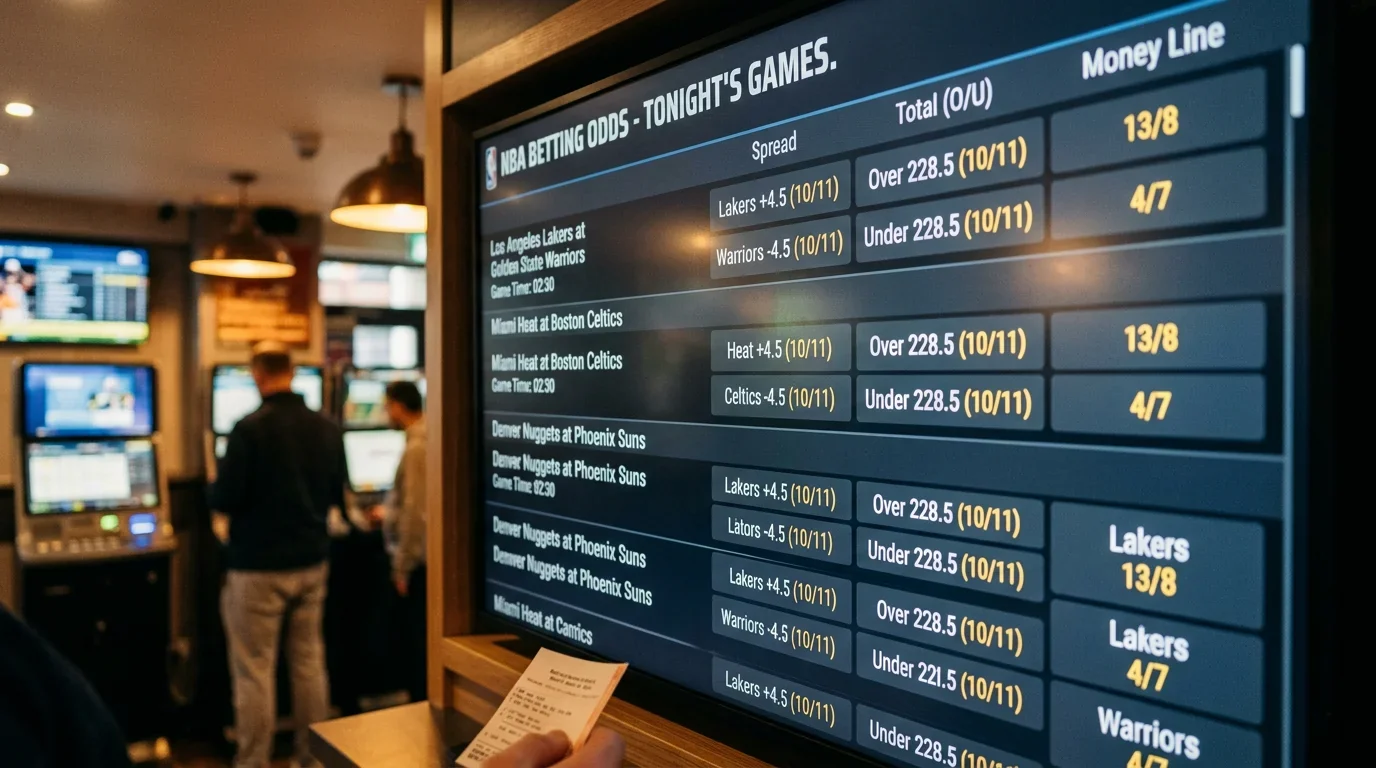
UK sportsbooks present moneyline as a two-way market — home team or away team. There is no draw option in the NBA (games go to overtime until someone wins), so you are always choosing between two outcomes. The odds reflect each team’s perceived chance of winning. A heavy favourite might be priced at 1/5 (decimal 1.20), meaning you would need to stake 50 pounds to profit 10. An underdog at 7/2 (decimal 4.50) returns 35 pounds profit on a 10-pound stake.
Here is a practical example. Say the Boston Celtics host the Charlotte Hornets on a Wednesday night. The sportsbook prices Boston at 1/6 and Charlotte at 4/1. Those odds tell you the market believes Boston wins roughly 85% of the time and Charlotte about 20% — notice those percentages add up to more than 100, because the bookmaker’s margin is baked in. That gap between the true probability and the implied probability is where the sportsbook makes its money, and it is worth understanding even on the simplest market.
Moneyline works best when you have a strong directional view on who wins but no conviction about the margin. It is also the default market for accumulators, since stacking several short-priced favourites into a multi-bet is how many UK punters approach NBA nights with a full fixture list. The downside is obvious: backing heavy favourites at 1/6 or 1/8 ties up capital for minimal return, and a single upset torpedoes the evening. I have learned the hard way that four “certainties” at 1/5 each still fail more often than the odds suggest, because NBA upsets cluster around back-to-back schedule spots and early-season variance.
One detail UK bettors sometimes miss: moneyline includes overtime. If the game is tied after 48 minutes and goes to an extra period, your bet rides. Some quarter or half-time markets settle on regulation only, but a moneyline wager always counts every minute of play until one team leads.
Point Spread (Handicap) Betting
The point spread is where I lost that first tenner in 2017, and it remains the most widely bet NBA market globally — for good reason. Spread betting levels the playing field between a dominant team and a weaker opponent by assigning a handicap. The favourite “gives” points, the underdog “receives” them, and the outcome is determined after the handicap is applied to the final score.
In UK terms, this is identical to what football bettors know as Asian Handicap, though NBA spreads almost always use half-points to eliminate the possibility of a push (a tied result after the handicap). If the Golden State Warriors are -5.5 against the Indiana Pacers, Golden State must win by 6 or more points for a spread bet on them to land. Indiana at +5.5 covers the spread if they win outright or lose by 5 or fewer.
Here is where it gets interesting for anyone who wants to move beyond moneyline: professional NBA handicappers — the people who do this full-time, with models and databases — hit spreads at roughly a 47% rate. Totals (over/under) fare slightly better at around 49%. The break-even point for standard -110 American odds (the typical vig on spreads) sits at 52.4%. That slim gap between the professionals and the break-even threshold tells you two things. First, beating the spread consistently is genuinely difficult. Second, it only takes a small, repeatable edge to turn a profit over hundreds of bets.
A worked example in pounds: you back the Miami Heat at -3.5 with fractional odds of 10/11, staking 22 pounds. Miami wins 112-107 — a five-point margin. Since 5 exceeds 3.5, your bet wins. The return is 22 pounds stake plus 20 pounds profit, for a total of 42 pounds. Had Miami won 112-109 — a three-point margin — your bet loses, because 3 does not beat 3.5. That half-point matters enormously, and many experienced bettors specifically seek out -3 instead of -3.5 (or +4 instead of +3.5) when alternative lines are available.
Spreads are priced close to even money on both sides, typically 10/11 or 5/6, which means the sportsbook expects roughly equal action on favourite and underdog. That near-even pricing also makes spreads the most efficient NBA market at UK books — the margins are thinner than on novelty or niche bets, so you lose less to the house edge per wager.
I use spreads as my bread-and-butter market for a simple reason: they force me to think about game dynamics, not just outcomes. Asking “will Denver win by 7?” demands a more precise analysis than “will Denver win?” — and that precision, over time, is where sustainable edge lives.
Over/Under (Totals)
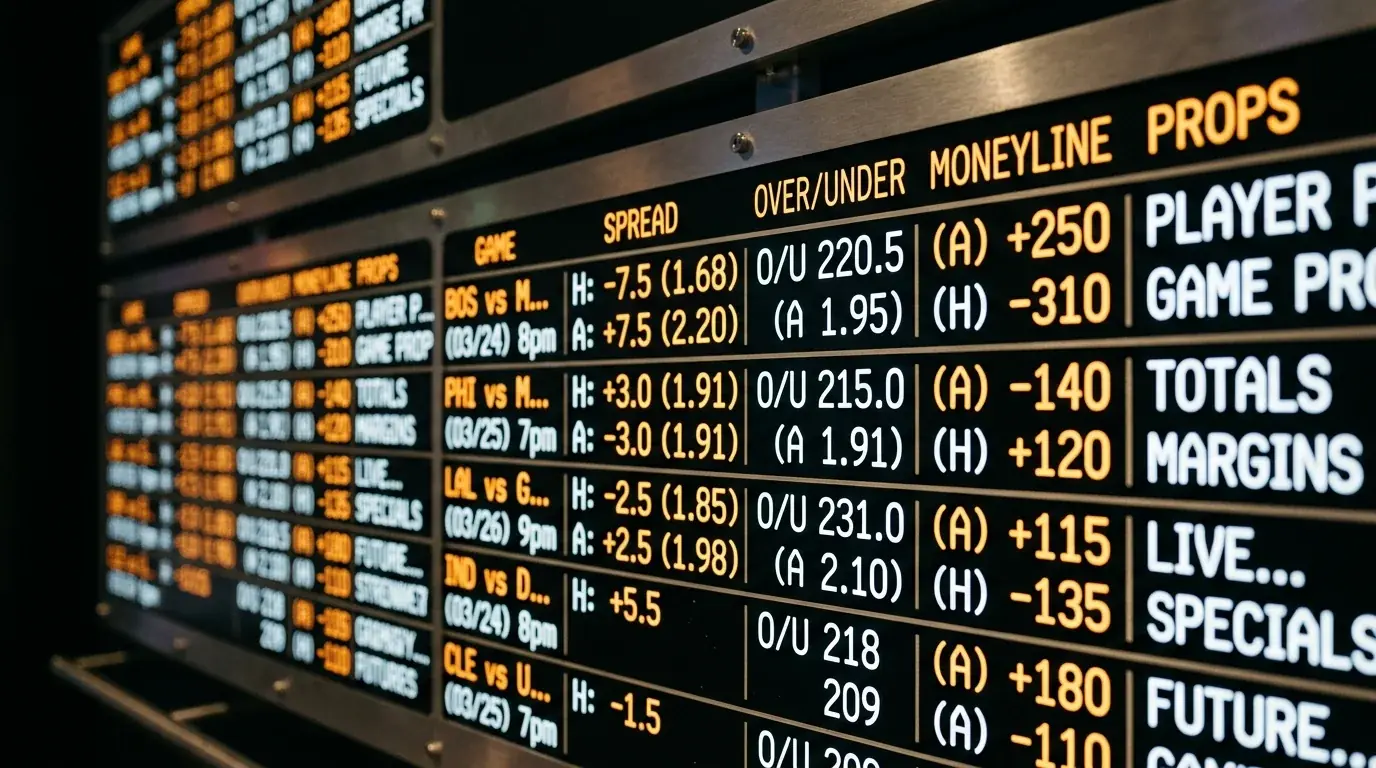
Totals — or over/under, as most UK sportsbooks label them — ask a completely different question from spreads and moneylines. You are not picking a winner. You are predicting whether the combined points scored by both teams will finish above or below a number set by the bookmaker. A typical NBA total might sit around 220.5 points, and you decide: over or under?
I gravitated toward totals early in my NBA betting career because they let me ignore team allegiance entirely and focus on pace and efficiency data. A matchup between two top-five offensive teams that both rank in the bottom ten defensively screams “over,” regardless of which side wins. That analytical purity appeals to anyone who prefers studying numbers over narratives.
Research by García and colleagues examined NBA shooting efficiency across game quarters and found a consistent decline as games progress, with an effect size of -1.27 between the first and fourth quarters. That is a meaningful drop, and it matters for totals: the pace of scoring in the first quarter does not simply continue at the same rate for the remaining three. If you watch the opening 12 minutes of a game and think “this is heading over 230,” remember that fourth-quarter fatigue, tighter rotations, and intentional fouling patterns all dampen scoring output later. The number setters know this. You should too.
Totals are priced similarly to spreads — expect odds around 10/11 or 5/6 on both the over and the under. UK sportsbooks also offer team totals, where you bet on one team’s individual score rather than the combined figure. These can be useful when you believe one side will be prolific but the opponent’s scoring output is unpredictable.
A quick example: the total for a Bucks-76ers game is set at 224.5. You stake 20 pounds on the over at 10/11. The game finishes 118-112, a combined 230. Your bet wins. The payout is 20 plus 18.18, totalling 38.18 pounds. Had the game finished 108-104 (212 combined), the under wins instead. The half-point again eliminates any possibility of a push.
One nuance to watch: totals include overtime scoring unless the sportsbook explicitly states “regulation only.” An NBA overtime period typically adds 8-12 points to the combined total, which can push a game that was tracking under the line firmly into over territory. If you are betting unders, overtime is your enemy.
Accumulators and Multi-Bet Options
If you have ever built a football accumulator on a Saturday afternoon, you already understand the principle. Accumulators — called parlays in American betting language — combine multiple individual selections into a single bet. Every leg must win for the bet to pay out, and the odds multiply together, producing returns that look far more exciting than any single wager could deliver.
NBA accumulators are popular for a straightforward reason: the league plays a dense schedule, with as many as 15 games on a single night. That volume creates the temptation to string together five or six moneyline favourites, each priced at 1/4 or 1/3, hoping they all hold. The combined odds on a five-leg NBA acca of short favourites might land around 3/1 to 5/1, which feels like decent value for teams “everyone knows” will win.
The maths, however, cuts in the opposite direction. Every leg you add multiplies the bookmaker’s margin alongside the odds. A single bet at 10/11 carries roughly a 4.5% house edge. Stack five of those and the cumulative margin balloons past 20%. That is why I treat accumulators as entertainment rather than strategy — they are fun, they generate occasional big nights, but they are structurally unfavourable over a long sample.
Most UK sportsbooks offer acca insurance or acca boosts on NBA, refunding your stake as a free bet if one leg lets you down. These promotions reduce the mathematical penalty, but they do not eliminate it. If you enjoy multi-bets, keeping them to three or four legs limits the compounding margin while still producing meaningful returns. And mixing market types — one moneyline pick, one spread, one total — diversifies the risk compared to stacking five moneylines that all correlate with each other on a busy night.
Bet Builder and Same-Game Combinations
Bet builders changed the way I watch NBA games. Instead of placing a moneyline single and passively hoping for a win, I can construct a wager that ties directly to my pre-game research: team wins, star player scores over 28.5 points, total goes over 215.5 — all in one bet, all on the same game. That specificity is addictive because it rewards granular preparation.
Every major UK-licensed sportsbook now offers a same-game parlay or bet builder for NBA fixtures, though the name varies. The tool lets you combine selections from different markets within one game into a single bet. The key distinction from a standard accumulator is that all legs come from the same event, which introduces correlation — the outcomes are not independent. A team winning by a large margin, for example, increases the likelihood that their star player scores heavily. Sportsbooks account for this correlation when pricing your bet builder, which is why the combined odds are usually lower than simply multiplying each leg’s individual odds together.
From a practical standpoint, I use bet builders most often for nationally televised UK games — the ones Sky Sports picks up on prime-time slots. When I have done the research on a specific matchup, watching one game with a carefully constructed three-leg bet builder generates far more engagement than scattering five moneyline singles across the evening’s slate. The entertainment factor is real, and for many UK punters, that is the primary appeal.
A word of caution I have earned through experience: the more legs you add, the harder the bet becomes to land, and the worse the effective odds get relative to fair probability. Three legs is my ceiling for bet builders. Four-plus legs look spectacular on a potential-winnings screen but rarely survive a full 48 minutes of NBA basketball.
Futures and Outright Markets
Futures are the long game of NBA betting — literally. You place a wager on an outcome that will not be settled for weeks or months: who wins the championship, who is named MVP, which team finishes with the most regular-season wins, whether a specific franchise makes the playoffs. The NBA ecosystem generates roughly $13.92 billion in value in 2026, and futures markets let you take a position on where that value concentrates over an entire season.
The attraction of futures is the odds. A championship outright on an underdog team in October might pay 40/1 or 50/1, turning a 10-pound stake into a 500-pound return if the season breaks your way. MVP markets, Rookie of the Year, and Defensive Player of the Year all carry similarly juicy prices for anyone willing to lock up capital for half a year.
Timing matters enormously. Championship odds shift throughout the season as injuries, trades, and performance data reshape the market. I have found that the best windows for value tend to open during the first two weeks of the season (when small sample sizes cause overreactions) and immediately after the trade deadline in February (when rosters change but odds lag behind the transactions). By playoff time, the market has tightened and the value is largely gone.
The downside is liquidity — your money is tied up until the market settles, which could be seven or eight months away. Some UK sportsbooks offer early cash-out on futures, allowing you to lock in a profit if your team’s odds shorten dramatically. That flexibility is worth checking before you commit, particularly on longer-duration bets.
Niche Markets: Winning Margin, Quarter Bets, and First Basket
Beyond the core markets, UK sportsbooks have expanded into territory that would have been unthinkable five years ago. These niche markets reward specialist knowledge and offer pricing that is often less efficient than the heavily bet spreads and totals — which, for a patient bettor, is exactly where edges emerge.
Winning margin betting asks you to predict the gap between the teams at full time, usually in bands: 1-5 points, 6-10, 11-15, 16-20, 21+. Research by Wang and colleagues, analysing 2,295 NBA games over a decade, found that 19% of games remain within 10 points entering the fourth quarter. That figure tells you the distribution of margins is not random — blowouts are less common than casual viewers assume, and tightly contested finishes cluster around specific ranges. If you study closing margins, you can find bands where the sportsbook’s pricing underestimates the true frequency.
Quarter and half-time bets let you isolate specific periods of the game. First-quarter spreads and totals are genuinely different beasts from full-game lines, because they strip out the variance of substitution patterns, late-game fouling, and overtime. Some bettors specialise entirely in first-half markets, using early-season data on starting-lineup efficiency before the rest of the market catches up.
First basket scorer is a market that looks like a pure coin flip but actually carries identifiable patterns. The team that wins the opening tip controls the first possession, and certain players — typically centres or power forwards who receive the ball immediately after the tip — score first at rates significantly above average. Jump-ball win rates for specific centre matchups are publicly available data, yet few bettors incorporate them. It is one of the few NBA markets where a 20-minute research session genuinely shifts the odds in your favour.
Player specials round out the niche category. Double-double bets (will a player record double figures in two statistical categories?), triple-double bets, and exact points scored markets all exist at UK sportsbooks for marquee games. The pricing on these markets tends to carry wider margins than spreads, but the informational advantage available to anyone who tracks minutes load and matchup history can partially offset the house edge.
Choosing the Right Market for Your Betting Style
NBA Commissioner Adam Silver once noted the tension between fan engagement and betting, observing that a team can win while its star scores 25 points, yet the bettor who backed that player at 28 or 30 still walks away frustrated. That observation captures something fundamental about market selection: the market you choose determines not just your expected return but your entire experience of watching the game.
Learn how NBA handicap betting works to level the playing field.
If you want simplicity and low house edge, spreads and totals are your foundation. They carry the tightest margins, attract the most liquidity, and offer the cleanest analytical framework. Most of my own NBA betting volume sits in these two markets, because the data infrastructure (pace ratings, net efficiency, rest schedules) maps directly onto spread and total predictions.
If you want engagement and narrative, bet builders and player props transform a random Wednesday-night game into something you care about for all four quarters. The trade-off is wider margins and more variance — you will lose more bets, but the ones you win will feel genuinely earned because they required multi-layered analysis.
If you want long-term positioning and are comfortable with illiquidity, futures markets let you express a seasonal thesis at prices that reward patience. I treat futures as a small allocation — never more than 5-10% of my NBA bankroll in any given season — because the capital lockup and the inability to react quickly to new information both work against you.
There is no single “correct” market. The right choice depends on your bankroll size, your time commitment to research, and whether you prioritise return on investment or entertainment value. What I can tell you from nine years of doing this is that the worst approach is no approach at all — drifting between markets based on whatever the sportsbook promotes on its homepage. Pick two or three market types, understand them deeply, and build your NBA betting around that core.
Frequently Asked Questions
What does +4.5 mean in NBA betting?
A line of +4.5 means the team is receiving a 4.5-point handicap. If you back them, they can lose the game by up to 4 points and your bet still wins. They need to either win outright or lose by fewer than 5 points for the wager to land. The half-point eliminates any possibility of a tied result after the handicap is applied.
What is the difference between NBA moneyline and spread betting?
Moneyline asks you to pick the outright winner — no margin required. Spread betting assigns a points handicap to level the contest, so the favourite must win by more than the spread and the underdog can lose by fewer points than the spread and still cover. Moneyline odds vary widely between favourite and underdog, while spread odds sit close to even money on both sides.
Can I combine different market types in a single NBA bet?
Yes. Most UK sportsbooks offer bet builder tools that let you mix moneyline, spread, totals, and player prop selections from the same game into one wager. You can also create standard accumulators combining selections from different games across any market types. Each added leg increases both potential return and risk.
Which NBA betting market has the lowest bookmaker margin?
Point spreads and game totals typically carry the thinnest margins at UK sportsbooks, usually around 4-5% overround. These markets attract the highest volume and the most sophisticated bettors, which forces sportsbooks to price them competitively. Niche markets like first basket scorer or exact winning margin carry wider margins, often 8-15% or more.
Created by the ”nba Betting Online” editorial team.