NBA Betting Odds Formats: Fractional, Decimal, and American Explained
 Available in US

I spent my first three months consuming American NBA betting content and being completely baffled by the numbers. Everyone talked about -110 and +150 while I was looking at 10/11 and 6/4 on my screen. It felt like the same sport was being discussed in two different languages, and in a sense it was. Understanding odds formats isn’t glamorous, but it’s the literacy that makes every other piece of betting analysis usable. If you can’t instantly convert between formats and calculate implied probability, you’re navigating the market with a blindfold on.
Explore nba betting online for all UK NBA wagering guides.
Fractional Odds: The UK Standard
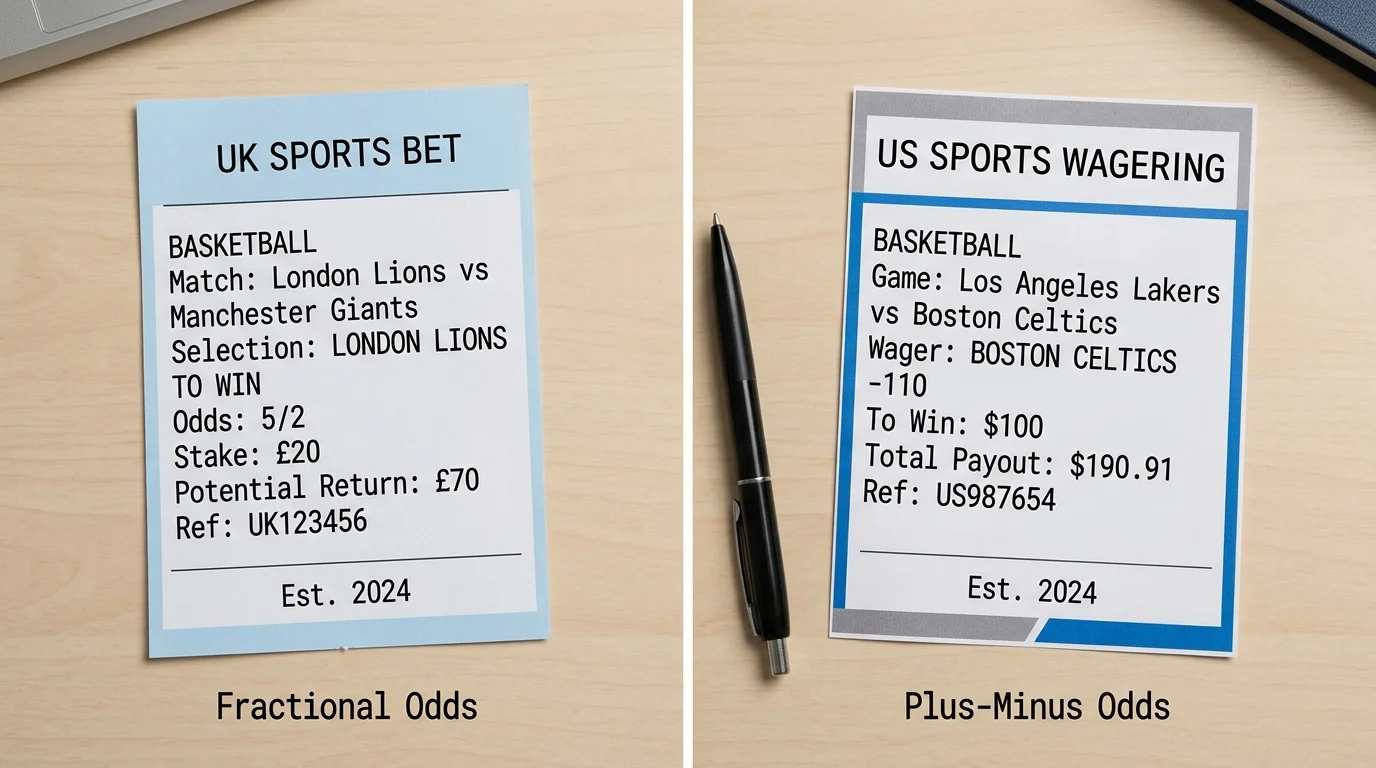
UK sportsbooks display fractional odds by default. The format shows your potential profit relative to your stake. Odds of 4/1 mean you win 4 pounds for every 1 pound staked. Odds of 1/4 mean you win 1 pound for every 4 pounds staked. The fraction always shows profit/stake.
Calculating your total return from fractional odds: multiply your stake by the fraction, then add your stake back. A 10-pound bet at 7/2 returns (10 x 7/2) + 10 = 35 + 10 = 45 pounds total, of which 35 is profit. At odds-on prices like 4/9, the maths is: (10 x 4/9) + 10 = 4.44 + 10 = 14.44 pounds total return.
Implied probability from fractional odds uses the formula: denominator / (numerator + denominator). Odds of 5/2 imply a probability of 2 / (5+2) = 28.6%. Odds of 1/3 imply 3 / (1+3) = 75%. This calculation is the bridge between odds and analysis — it tells you what win rate you need at a given price to break even. If the bookmaker prices a team at 5/2 (28.6% implied), and your analysis says they win 35% of the time, the bet has positive expected value.
NBA betting content from the UK uses fractional odds almost exclusively. The $77 billion media rights deal has brought more NBA content to British screens through Sky Sports and streaming services, but the analytical ecosystem remains American-dominated, which is why understanding American odds is equally important for anyone consuming research from across the Atlantic.
Decimal Odds: The European Standard
Decimal odds represent your total return per unit staked, including the stake itself. Odds of 3.50 mean a 10-pound bet returns 35 pounds total (10 x 3.50). Odds of 1.40 return 14 pounds on a 10-pound stake. The simplicity is the selling point — multiplication gives you the total return in a single step.
Converting between fractional and decimal: add 1 to the fractional odds expressed as a decimal. Fractional 7/2 = 3.5 + 1 = 4.50 decimal. Fractional 4/9 = 0.444 + 1 = 1.444 decimal. Going the other way: subtract 1 from the decimal odds, then convert the result to a fraction. Decimal 2.75 = 1.75 = 7/4 fractional.
Implied probability from decimal odds is even simpler: 1 / decimal odds. Decimal 2.50 implies 1/2.50 = 40%. Decimal 1.80 implies 1/1.80 = 55.6%. I set my sportsbook accounts to display decimal odds because the implied probability calculation is faster in my head, and when you’re evaluating five or six bets in rapid succession, those seconds of mental arithmetic compound into better decisions. Most UK sportsbooks let you toggle between formats in the settings — it’s usually one click.
American Odds: Reading the Language of US NBA Content
American odds use positive and negative numbers anchored to 100. Negative odds tell you how much you must stake to win 100 units. Positive odds tell you how much you win from a 100-unit stake. -150 means stake 150 to win 100. +200 means stake 100 to win 200.
The conversion to implied probability: for negative odds, divide the absolute value by (absolute value + 100). -150 implies 150/250 = 60%. For positive odds, divide 100 by (odds + 100). +200 implies 100/300 = 33.3%. To convert American to decimal: for negative odds, divide 100 by the absolute value and add 1. -150 = (100/150) + 1 = 1.667. For positive odds, divide by 100 and add 1. +200 = (200/100) + 1 = 3.00.
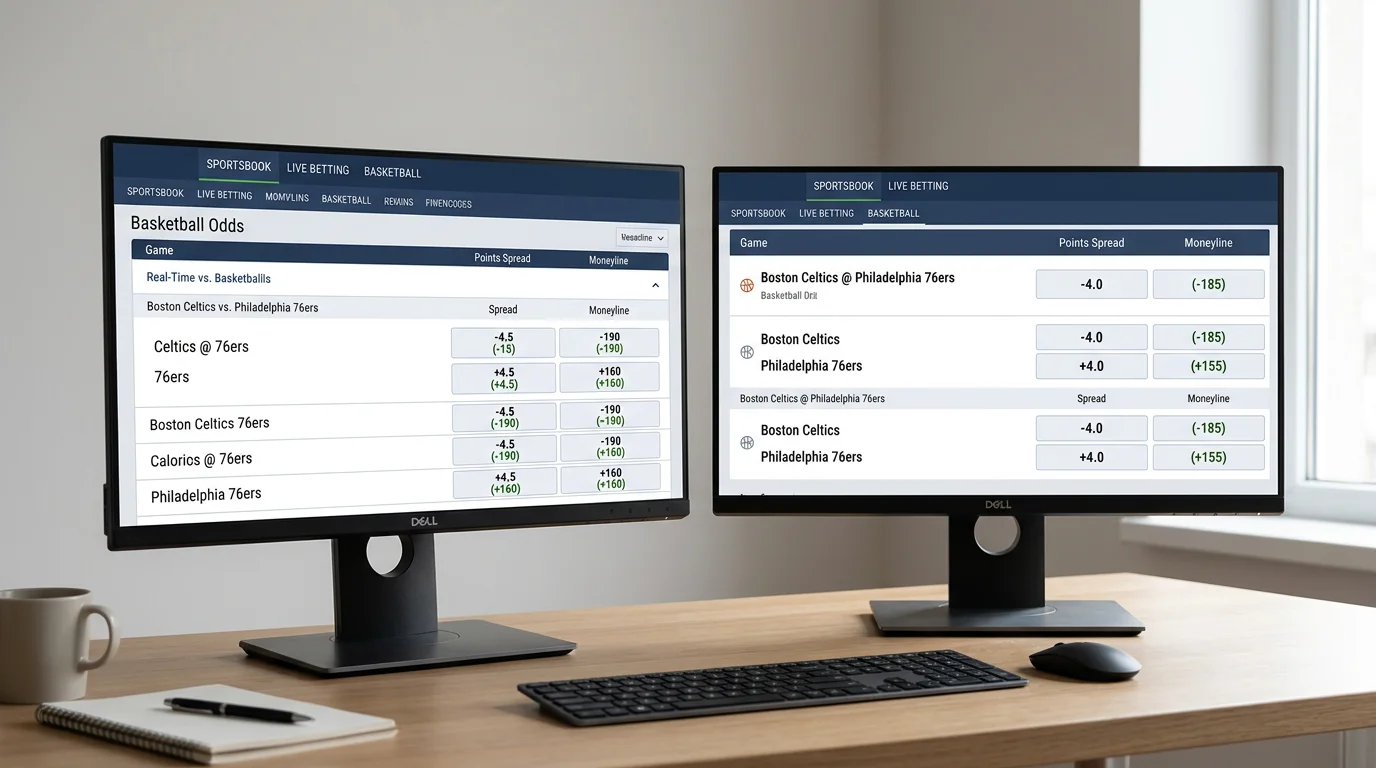
Every serious NBA betting podcast, Twitter account, and analytical article from the US quotes American odds. If you consume any of that content — and you should, because the US analytical community is deeper and more data-driven than the UK equivalent for basketball — you need to read American odds as fluently as you read fractional. I keep a mental shorthand: -110 is roughly even money (10/11), -200 is 1/2, +150 is 3/2, +300 is 3/1. Those anchors let me process American odds on the fly without pulling out a calculator.
Why the Overround Matters More Than the Format
Every odds format hides the same structural reality: the bookmaker’s margin. If a game has two possible outcomes and both are priced at 10/11 (1.909 decimal), the implied probability of each side is 52.4%. The sum — 104.8% — exceeds 100% by 4.8 percentage points. That excess is the overround, and it’s the bookmaker’s built-in profit margin.
Understand the regulatory side in our NBA betting legal UK overview.
Lower overrounds mean better value for the punter. An overround of 4% means you’re paying less for the same bet than at an operator with an overround of 7%. Comparing overrounds across UK sportsbooks for the same NBA game takes 30 seconds and can save you meaningful money over a season. The difference between 10/11 and 5/6 on the same selection doesn’t sound dramatic, but across 300 bets per season the cumulative impact on your return is substantial.
Remote Gaming Duty rising to 40% from April 2026 has increased the pressure on operator margins. The projected revenue from duty changes — 810 million pounds in 2026/27 — comes partly from wider overrounds that operators pass through to punters. Comparing odds across multiple operators is more important now than in any previous season, because the margin spread between operators has widened as each absorbs the tax increase differently. If you’re exploring how odds connect to broader NBA betting market types, understanding the overround on each market is what separates informed punters from those who accept whatever price they see first.
What odds format do UK sportsbooks use for NBA betting?
UK sportsbooks default to fractional odds, showing potential profit relative to your stake. Most operators let you switch to decimal or American format in your account settings. Decimal odds are popular among analytical bettors because the implied probability calculation is simpler. American odds are useful for consuming US-based NBA analysis.
How do I calculate implied probability from NBA odds?
For fractional odds, divide the denominator by the sum of numerator and denominator. For decimal odds, divide 1 by the decimal. For American odds, divide the absolute value by the absolute value plus 100 for negative odds, or divide 100 by the positive odds plus 100. The result tells you the breakeven win rate at that price.
Prepared by the nba Betting Online editorial staff.