NBA Betting Exchanges in the UK: Trading Basketball Like a Market
 Available in US
The moment I understood betting exchanges, everything about traditional bookmaking suddenly looked quaint. I was watching a Celtics-76ers game, holding a pre-game bet on Boston at 1.85. By half-time, the Celtics were up fourteen and the live odds had dropped to 1.12. With a traditional bookmaker, my choices were limited to cashing out at whatever they offered. On the exchange, I laid Boston at 1.15 and locked in a profit regardless of the second half. That ability to trade in and out of positions — to act as both backer and layer — changed the way I thought about NBA betting entirely.
Visit nba betting online for comprehensive NBA resources.
What Makes an Exchange Different from a Bookmaker
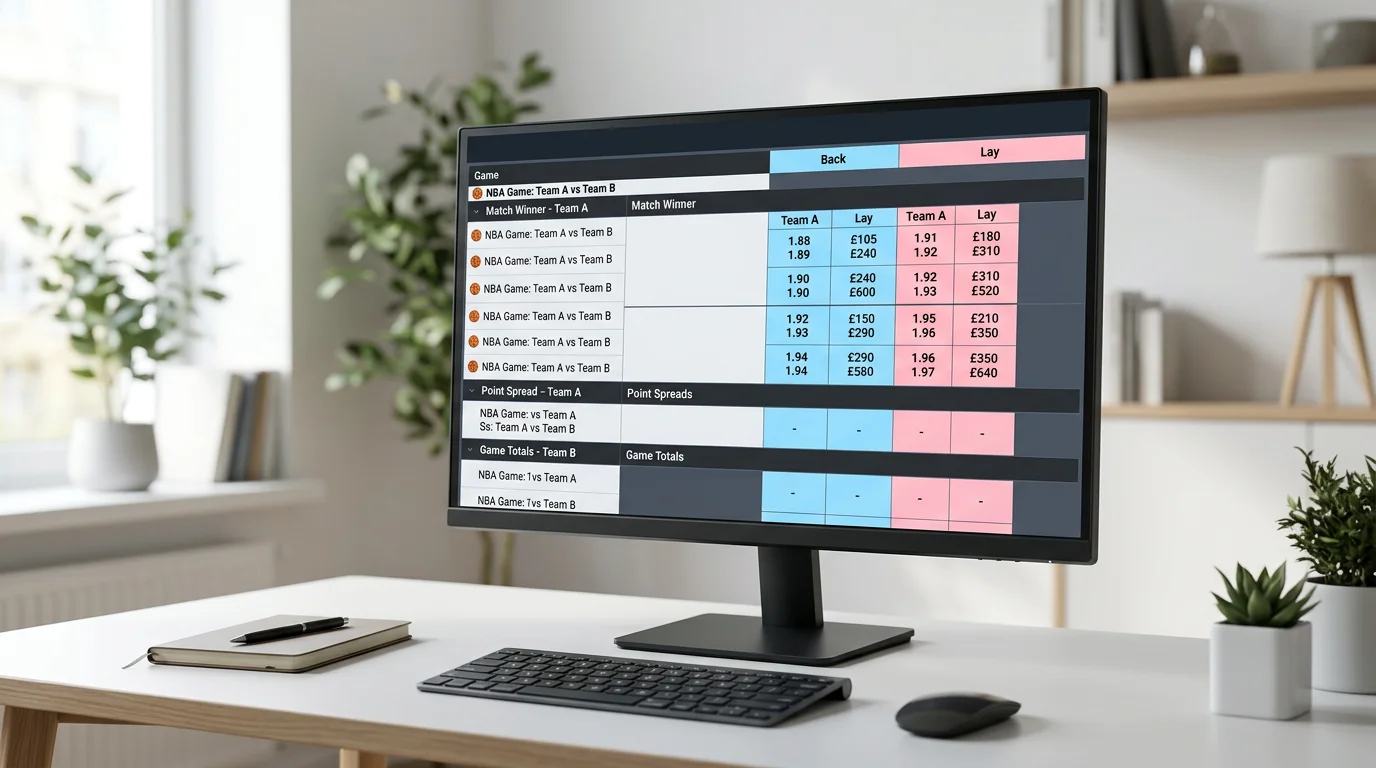
I used to explain exchanges to friends by asking them to imagine a stock market for sports bets. Instead of one company setting the odds and taking the other side of every wager, an exchange is a platform where punters bet against each other. The exchange takes a small commission on winning bets — typically between 2% and 5% — and stays neutral on the outcome.
This peer-to-peer model has two fundamental advantages. First, the odds are almost always better than what a traditional bookmaker offers, because there is no built-in margin on every price. A bookmaker might offer the Lakers at 1.90 when the true probability is 50-50 — the missing 0.10 is their margin. On an exchange, you might find 1.98 on the same outcome because another punter is willing to take the other side at that price. Over hundreds of bets, that difference compounds significantly.
Second, and this is the part that changes everything: you can lay. Laying means betting against an outcome — essentially acting as the bookmaker. If you think the Knicks are overvalued at 1.70, you do not need to find a more attractive alternative. You simply lay them at 1.70 and profit if they lose. In traditional betting, you can only back outcomes. On an exchange, you can back, lay, and trade between the two. The NBA betting ecosystem, valued at $13.92 billion globally in 2026, increasingly flows through platforms that offer this flexibility.
Liquidity: The Exchange’s Achilles Heel for NBA
Here is where I need to be honest about the limitations. Exchanges work brilliantly for high-liquidity markets — Premier League match odds, for instance, attract millions in matched bets. NBA markets on UK exchanges are thinner. Not empty, but thinner. And liquidity is everything on an exchange, because without someone to take the other side of your bet, the best odds in the world are just numbers on a screen.
From my experience, NBA exchange liquidity follows predictable patterns. Marquee matchups — Lakers-Celtics, playoff games, the Finals — attract reasonable volume. A random Tuesday night game between the Pacers and the Hornets does not. Moneyline and spread markets are far more liquid than player props or exotic bets. Pre-game markets build liquidity through the day but peak about an hour before tip-off. Live markets fluctuate with the game’s significance.
The practical implication: if you want to place a large bet on an obscure NBA market via an exchange, you may not get fully matched. Your bet might sit partially filled or unfilled entirely. For major markets on major games, exchanges compete well with bookmakers on both odds and available volume. For niche markets, you will probably need to use a traditional operator.
Trading NBA Games In-Play
Last January I watched a Nuggets game that perfectly illustrated exchange trading. Denver fell behind by eighteen points in the first half, and the live exchange odds drifted out to 4.50. I knew the Nuggets had the league’s best third-quarter point differential and Nikola Jokic had been passive in the first half — a pattern that usually corrects itself. I backed Denver at 4.50. By the end of the third quarter, Denver had cut the lead to four and the exchange price had dropped to 1.65. I laid at 1.65 and guaranteed myself a profit on both sides.
That is trading — and it is the single biggest advantage exchanges offer for NBA betting. You are not locked into a position until the final buzzer. Every shift in momentum, every run, every timeout is an opportunity to adjust. This is especially powerful in basketball because the sport produces enormous swings. A team can trail by fifteen and lead by five within a single quarter. Those swings create price movement, and price movement is where exchange traders make money.
The mechanics are straightforward once you grasp the principle. If you back at high odds and the price drops, you lay at the lower price and lock in a profit. If you back and the price drifts higher — meaning your position is losing — you can lay at the higher price to cut your losses. It mirrors stop-losses and take-profit orders in financial trading, and the mindset translates directly. Around 10% of UK adults engage in online sports betting, and the subset that uses exchanges tends to be the most analytically minded of that group.
Commission Structures and the True Cost of Exchange Betting
Nothing is free, and exchanges are no exception. The commission on winning bets typically runs between 2% and 5%, depending on the platform and your activity level. High-volume users negotiate lower rates. This commission replaces the bookmaker’s margin — and it is almost always cheaper, but only if you factor it into your calculations.
Here is an example that catches some people out. You back a team at 2.00 for 100 pounds and win. Your gross profit is 100 pounds. At a 5% commission rate, you pay 5 pounds in commission and net 95 pounds. That effective return is 1.95, not 2.00. If you had the same bet at a traditional bookmaker offering 1.95, there is no advantage. The exchange only saves you money when the odds gap exceeds the commission rate.
For NBA bets where the exchange price is significantly better than the bookmaker price — which is common on main markets — the commission is a small price to pay. For markets where the exchange price is only marginally better, the maths is tighter. I run a simple comparison before every bet: exchange odds minus commission versus best available bookmaker price. The answer is not always the exchange, and pretending otherwise is how people lose money while feeling clever.
Exchange Strategies Specific to NBA Basketball
Certain NBA-specific dynamics make exchange trading particularly interesting. The pace of the sport means odds shift frequently and by large amounts during live play. A three-pointer can swing the exchange price by 0.10 to 0.15 in seconds — that is a tradeable move on a sufficiently large stake.
One strategy I use regularly: backing heavy underdogs before tip-off when the price is at its widest, then laying off during the game if they keep it close early. NBA underdogs cover the spread roughly 47-49% of the time, and many games that finish as comfortable wins for the favourite are competitive through the first half. If you back a +10 underdog before the game and they are only down three at half-time, the live exchange price will have moved significantly in your favour — even if the favourite eventually pulls away.
Another approach works around timeouts and quarter breaks. Exchange prices often overreact to the last few possessions before a break. If a team goes on a 7-0 run to end the second quarter, the half-time exchange price will be skewed by that run. If you have watched enough basketball to know that these runs frequently reverse — particularly when the trailing team gets to make adjustments at the break — you can find value in the overcorrection.
Practical Considerations for UK Exchange Users
The UK regulatory environment adds specific considerations for exchange bettors. Commission on exchange winnings is subject to the same Remote Gaming Duty structure as traditional betting, so the regulatory cost flows through to you indirectly via commission rates. The increase in Remote Gaming Duty to 40% from April 2026 has put upward pressure on exchange commission rates — some platforms have already adjusted their fee structures accordingly.
Maximise your exchange winnings with NBA free bets in the UK.
Account restrictions are less of a concern on exchanges than with bookmakers. Because the exchange profits from commission rather than from you losing, they have no incentive to restrict winning customers. In fact, winning customers generate more commission. This is the single most underappreciated advantage of exchange betting: you will never be gubbed for being profitable. For serious NBA bettors who have experienced account limitations at traditional operators, this alone can justify the switch.
The timing issue remains, though. NBA games starting between 11:00 PM and 4:00 AM GMT means live exchange trading happens at antisocial hours. Pre-game markets are accessible during UK daytime, and that is where most of the liquidity builds. But the real trading opportunities come during live play, and that requires being awake at unconventional times. There is no way around this — it is the fundamental scheduling challenge for any UK-based NBA bettor, exchange or otherwise.
Can I use a betting exchange alongside traditional bookmakers?
Absolutely — and most sharp bettors do exactly that. Use the exchange for markets where the odds advantage outweighs the commission, and traditional bookmakers for niche markets with poor exchange liquidity. The two approaches complement each other.
What happens if my exchange bet is not matched?
Unmatched bets remain open until the market closes or you cancel them. You can adjust your price to increase the chance of getting matched, or leave the bet at your preferred odds and accept it might not fill. You are only charged commission on bets that are matched and won.
Are exchange winnings taxed differently in the UK?
No. In the UK, all gambling winnings — whether from a bookmaker or an exchange — are tax-free for the punter. The operator pays Remote Gaming Duty, but this is not deducted from your winnings directly. You keep what you win, minus the exchange’s commission.
Created by the ”nba Betting Online” editorial team.