NBA Arbitrage Betting: Finding Guaranteed Profit Between the Lines
 Available in US
The first time I found a genuine NBA arbitrage opportunity, I thought I had made a calculation error. Two different bookmakers had priced the same Bucks-Heat moneyline so differently that backing both sides guaranteed a profit regardless of the result. I triple-checked the maths, placed both bets, and made a 3.2% return in about ninety minutes. It felt like finding a twenty-pound note on the pavement — except the pavement was made of data, and you needed a spreadsheet to see it.
Arbitrage betting — arbing, in the shorthand — exploits pricing discrepancies between bookmakers. In theory, it is risk-free profit. In practice, it is considerably more complicated than that, especially in a sport as fast-moving as basketball. But the opportunities are real, they occur regularly in NBA markets, and understanding how they work will make you a sharper bettor even if you never place a pure arb.
See also: nba betting online for the latest NBA wagering guides.
How NBA Arbitrage Actually Works
I always explain arbing using a coin-flip analogy. Imagine one bookmaker offers you 2.10 on heads and another offers 2.10 on tails for the same coin flip. If you bet ten pounds on each side, you spend twenty pounds total and receive twenty-one pounds back regardless of the outcome. That one-pound profit — a 5% return — is the arbitrage.
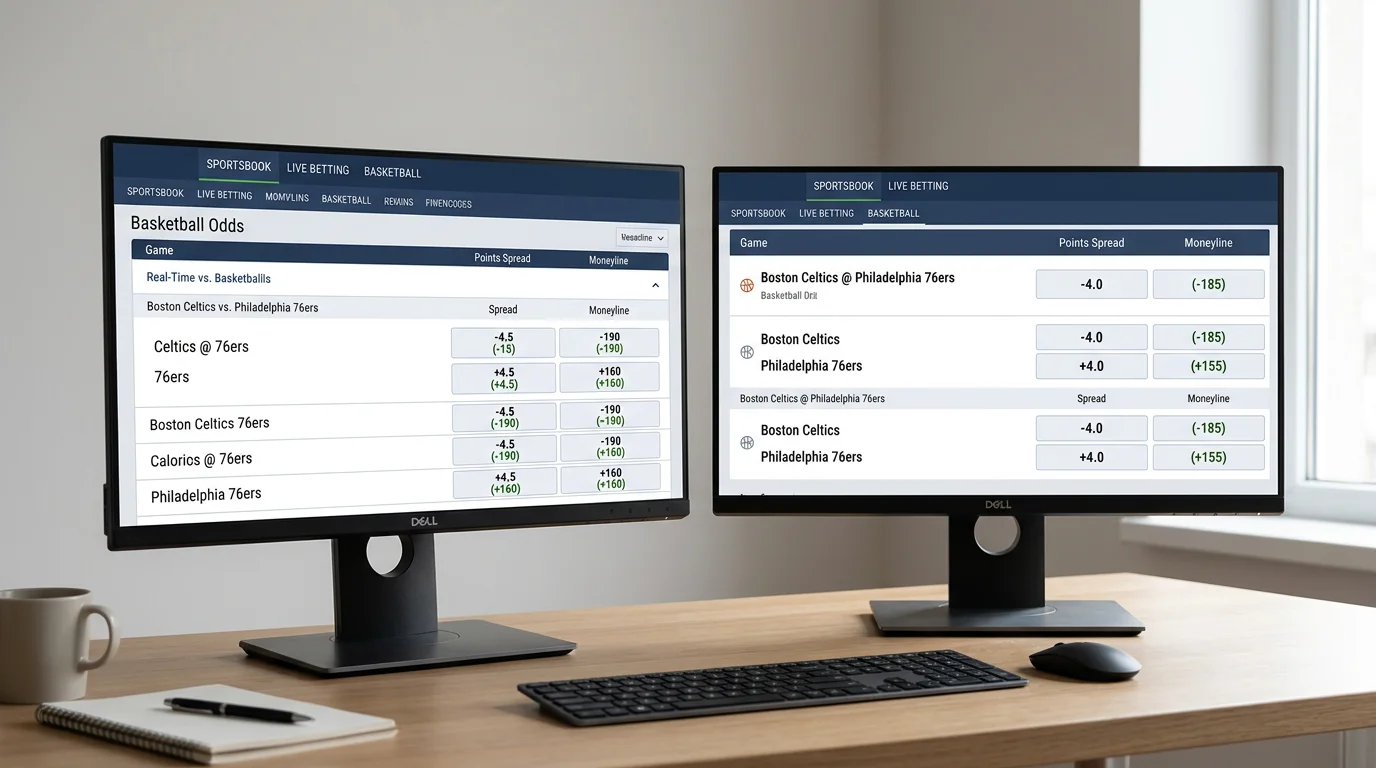
With NBA games, the principle is identical but the maths is more complex. You need to find a game where the combined implied probabilities across two or more bookmakers add up to less than 100%. This happens when different operators disagree about the likely outcome — and in a league with thirty teams, nightly schedule quirks, and constant injury news, they disagree more often than you might expect.
The formula is simple. Take the best available odds for each outcome, convert them to implied probabilities (1 divided by the decimal odds), and add them together. If the total is below 1.00, an arb exists. The gap between 1.00 and your total is your guaranteed profit margin. On a typical NBA moneyline, these gaps tend to range from 0.5% to 4% — small in absolute terms, but risk-free by definition.
Basketball generates 15 to 18% of global bookmaker activity, which means the NBA market is liquid and heavily traded. That liquidity creates both opportunity and competition: more money flowing through the market means more price movement, but it also means discrepancies get corrected quickly.
Where NBA Arbs Appear Most Often
Not all NBA markets produce arbs at the same rate. I have tracked my own opportunities over three seasons, and the pattern is consistent. The richest hunting grounds are player prop markets, followed by totals, followed by moneylines. Spreads produce the fewest arbs because they are the most heavily traded and the most efficiently priced.
Player props are where the real action is. Different bookmakers use different models to set lines on things like points, rebounds, and assists. One operator might lean heavily on season averages while another weights recent form more aggressively. When a player has a hot streak or a cold stretch, these models diverge, and the odds gap widens. I have found arbs on player points totals that lasted for hours because the market simply was not liquid enough for the discrepancy to correct itself.
Timing matters enormously. The window around injury announcements is golden. When a starting centre is ruled out ninety minutes before tip-off, some operators adjust their totals and spreads within minutes while others take half an hour. That delay creates a temporary pricing mismatch that an arber can exploit. The NBA ecosystem is worth $13.92 billion globally in 2026, and even tiny inefficiencies in a market that size translate to real money.
Late-night games — the ones tipping off at 3:00 AM or 4:00 AM UK time — also produce more arbs. The operators’ trading desks are running on skeleton crews, automated systems handle more of the pricing, and fewer punters are watching the markets. It is the same principle as any other market: less oversight means more mispricing.
The Maths Behind Stake Calculation
Finding an arb is only half the job. You also need to calculate exactly how much to stake on each side to guarantee a profit. Get the ratios wrong and you can end up with a net loss on one outcome — which defeats the entire purpose.
Here is a worked example. Say the Lakers are playing the Warriors. Bookmaker A has the Lakers moneyline at 2.25. Bookmaker B has the Warriors moneyline at 1.95. The implied probabilities are 1/2.25 = 0.4444 and 1/1.95 = 0.5128. The sum is 0.9572 — below 1.00, so an arb exists with a 4.28% margin.
To calculate stakes, you divide each implied probability by the total and multiply by your total bankroll for the arb. If you are putting 100 pounds in play: Lakers stake = (0.4444 / 0.9572) x 100 = 46.43 pounds. Warriors stake = (0.5128 / 0.9572) x 100 = 53.57 pounds. If the Lakers win, you receive 46.43 x 2.25 = 104.47 pounds. If the Warriors win, you receive 53.57 x 1.95 = 104.46 pounds. Either way, you profit roughly 4.46 pounds on 100 pounds wagered.
The numbers are not exciting on a per-bet basis. But arbing is a volume game. Place twenty of these a week at a 2% average margin on 200-pound stakes, and you are looking at 80 pounds in risk-free weekly profit. Scale that up and the maths becomes compelling.
Why Bookmakers Do Not Like Arbers
I lost my first account to gubbing — the industry term for when a bookmaker restricts your stakes or closes your account — after about six weeks of consistent arbing. I was not subtle about it. Identical stake sizes, always backing the less popular side, no interest in promotions or casual bets. The pattern was obvious to anyone looking.
Bookmakers actively monitor for arbitrage behaviour. Their systems flag accounts that consistently take the best available price, bet on both sides of a market (even across different operators in the same corporate group), or only ever bet on lines that are out of step with the market consensus. When flagged, the usual progression is reduced maximum stakes, then suspended promotional offers, then outright account closure.
This is the central tension of arbing: it works mathematically but it has a finite lifespan on any given platform. Every successful arb makes the next one harder to place, because the bookmaker gradually removes your ability to access the odds that make arbing possible. Some arbers manage accounts carefully — mixing in casual bets, varying stake sizes, using round numbers — to delay detection. Others treat accounts as disposable and burn through them quickly.
Tools and Timing for UK-Based NBA Arbers
Manual arb detection is theoretically possible but practically absurd for NBA markets. The odds move too quickly and the number of simultaneous games is too high. Every serious arber uses software — either a dedicated arb finder or an odds comparison tool that calculates margins automatically. These tools scan multiple bookmakers in real time and flag opportunities the moment they appear.
For UK bettors, the timing challenge is real. NBA games tip off between 11:00 PM and 4:00 AM GMT during the regular season, which means prime arbing hours overlap with sleeping hours. Some bettors set alerts for high-value arbs and wake up to place them. Others focus on the earlier tip-offs — the 11:00 PM and midnight games — and accept that they will miss opportunities on the West Coast slate.
The pre-game window is usually the most productive period. Lines are released six to twelve hours before tip-off, and the early prices often contain the largest discrepancies. As more money enters the market and the odds converge, the arb opportunities shrink. By thirty minutes before tip-off, the most obvious mispricing has usually been corrected.
Arbing as Education, Not Just Profit
Even if you never place a pure arbitrage bet, understanding arbing makes you a fundamentally better NBA bettor. It teaches you to think about odds as prices set by competing businesses, not as objective measures of probability. It trains your eye to spot when a line is out of step with the market. And it gives you a framework for identifying value that goes beyond gut feeling.
Learn how to spot NBA value betting opportunities for consistent profits.
The discipline required for arbing — tracking odds across platforms, calculating precise stakes, managing multiple accounts, executing quickly — transfers directly to other forms of sharp betting. I stopped arbing regularly two years ago, mainly because account restrictions made it unsustainable at the scale I wanted. But the habits I built during that period — the obsessive price comparison, the refusal to accept bad odds, the understanding that a 1% edge matters — inform every bet I place today.
Arbing is not a long-term strategy for most people. The accounts get restricted, the margins are thin, and the hours are unsociable for UK-based NBA bettors. But as a learning tool and an occasional source of risk-free returns, it has a legitimate place in any serious bettor’s toolkit. The opportunities exist because the market is imperfect — and a $13.92 billion market with thirty teams, eighty-two game seasons, and hundreds of nightly player prop lines will always have imperfections to find.
Is arbitrage betting legal in the UK?
Yes. Arbitrage betting is entirely legal under UK law. You are simply placing bets at the best available odds with different licensed operators. However, bookmakers have the right to restrict or close accounts of customers they suspect of arbing, which is a commercial decision rather than a legal matter.
How much starting capital do I need for NBA arbing?
Most arbers start with a bankroll of 500 to 2,000 pounds spread across multiple bookmaker accounts. Since typical arb margins range from 1% to 4%, you need sufficient capital to make the returns meaningful. A 2% margin on a 50-pound stake nets one pound — viable at volume, but you need enough accounts and bankroll to generate volume.
Do arb opportunities exist during live NBA games?
They do, but they are much harder to exploit. Live odds change rapidly, and the window to place both sides of an arb might only last seconds. Latency between bookmaker platforms can also mean the odds have shifted by the time your second bet is confirmed. Pre-game arbing is more reliable for most bettors.
Published by the nba Betting Online team.