NBA Betting Odds Explained: A UK-Focused Breakdown
 Available in US
Table of Contents
- NBA Betting Odds Explained: A UK-Focused Breakdown
- Fractional Odds: The UK Standard
- Decimal Odds and Quick Payout Calculations
- American Odds: Reading Plus and Minus Lines
- Converting Between Formats
- Implied Probability and Overround
- Why NBA Odds Move: Injury Reports, Sharp Action, and Volume
- Reading an NBA Odds Board at a UK Sportsbook
- Frequently Asked Questions
NBA Betting Odds Explained: A UK-Focused Breakdown
The first NBA bet I ever placed was on the Boston Celtics moneyline at 4/7. I knew that meant they were favourites. I knew I would win less than I staked. Beyond that, I had no real grasp of what the number was telling me — how it mapped to probability, why the sportsbook chose that specific fraction, or what it meant for my long-term returns. I won the bet, pocketed a few pounds, and assumed that understanding odds was a problem for maths graduates, not casual punters. That assumption cost me years of value.
Odds are the language of sports betting. Every number on a sportsbook’s NBA board is encoding two things simultaneously: the implied probability of an outcome and the return you receive if that outcome happens. Understanding how to read and interpret odds is not a nice-to-have skill — it is the foundational skill from which every other betting decision flows. You cannot identify value, compare sportsbooks, or manage a bankroll without it.
The UK sports betting market generates approximately 2.48 billion pounds in gross gaming yield each year, and a significant portion of that revenue comes from punters who bet without fully understanding the odds they are accepting. This guide breaks down the three odds formats you will encounter when betting on the NBA from the UK — fractional, decimal, and American — and shows you how to convert between them, calculate implied probability, identify the sportsbook’s built-in margin, and read line movements that signal where the smart money is going.
We start with fractional odds because they are the UK default, but I will be blunt: decimal odds are mathematically simpler for calculation purposes, and American odds are what you will see on most NBA-focused content from across the Atlantic. Being fluent in all three formats is a practical necessity, not academic exercise.
See also: nba betting online for a complete guide to NBA wagering.
Fractional Odds: The UK Standard
Walk into any high-street bookmaker in Britain and the odds board is fractional. It is the format most UK punters grow up with, and for NBA betting, it remains the default display on most UK-licensed sportsbooks unless you manually switch to decimal or American in your account settings.
Fractional odds express your potential profit relative to your stake. At 5/2, you win 5 pounds for every 2 pounds staked — plus your original stake back. A 20-pound bet at 5/2 returns 70 pounds total: 50 pounds profit plus 20 pounds stake. At 1/3, you win 1 pound for every 3 staked — a 30-pound bet at 1/3 returns 40 pounds total: 10 pounds profit plus 30 pounds stake. The first number is always the profit; the second is the stake required to earn that profit.
For NBA betting, the fractions you encounter most often are tight. Spread bets commonly sit at 10/11 on both sides (sometimes written as 10/11 or displayed as evens with a half-point adjustment). Moneylines on competitive games might be 5/6 and evens, or 4/5 and evens. When a team is a heavy favourite — the sort of line you see when a top contender hosts a bottom-three side — the moneyline might drop to 1/6 or 1/8, meaning you risk 6 or 8 pounds to profit just 1.
The mental arithmetic with fractional odds can be cumbersome during live betting when decisions need to happen quickly. Dividing 10 by 11 in your head while an NBA game clock is running is not impossible, but it is slower than glancing at a decimal price. I use fractional odds for pre-game analysis — they feel intuitive for assessing whether a price looks right — and switch to decimal for in-play calculations and comparison shopping. That hybrid approach leverages the familiarity of fractions without being slowed by their arithmetic demands.
One quirk worth noting: fractional odds do not always simplify to their lowest terms at UK sportsbooks. You might see 10/11 rather than an equivalent simplified fraction, because that specific expression maps to a standard industry price point. Similarly, 11/10 is a standard fraction for a slight underdog on the spread, not a random number. These price points repeat across the NBA board once you know what to look for.
Decimal Odds and Quick Payout Calculations
Decimal odds clicked for me the moment I realised they are just a multiplier. Your total return equals stake multiplied by the decimal number. A 20-pound bet at 2.50 returns 50 pounds. A 20-pound bet at 1.33 returns 26.60 pounds. No fractions, no mental division — one multiplication gives you the answer.
The decimal format is standard across Continental Europe and is increasingly popular among UK bettors, particularly those who wager on international sports or follow NBA content from European analysts. Every major UK sportsbook lets you toggle to decimal display in your settings, and I would recommend doing so if you regularly compare odds across platforms, because decimal prices are faster to compare at a glance.
Consider this practical comparison. Two sportsbooks offer the Milwaukee Bucks moneyline. Sportsbook A prices it at 8/11. Sportsbook B prices it at 1.75. Which is better? In fractional form, you need to convert 8/11 to a decimal: (8 divided by 11) plus 1 equals approximately 1.727. Now the comparison is instant — 1.75 is the better price. This kind of rapid comparison is precisely why decimal odds dominate in environments where line shopping is standard practice.
For accumulators, decimal odds are even more useful. Multiply the decimal prices of each leg together and you get the combined odds. A three-leg accumulator at 1.90, 2.10, and 1.80 gives combined odds of 7.182 — stake 10 pounds and the return is 71.82 pounds. Try doing that with fractional odds (9/10, 11/10, 4/5) and you will understand why accumulators are calculated in decimal behind the scenes regardless of what your sportsbook displays.
The one adjustment for UK punters is that decimal odds always include the returned stake in the total payout figure. At 2.00 (equivalent to evens or 1/1), you are doubling your money — not making 200% profit. This trips people up when switching from fractional for the first time. Profit is always the decimal price minus 1, multiplied by your stake.
American Odds: Reading Plus and Minus Lines
If you follow NBA betting content from the US — podcasts, Twitter accounts, Reddit threads — you will encounter American odds constantly. They look different from anything on a UK sportsbook, and the plus/minus system is initially confusing. But the logic, once you see it, is straightforward.
American odds use a baseline of 100 pounds (or dollars). A minus figure tells you how much you need to stake to win 100. A plus figure tells you how much you win from a 100-pound stake. At -150, you stake 150 to win 100 (total return 250). At +130, you stake 100 to win 130 (total return 230). The minus sign always indicates the favourite; the plus sign always indicates the underdog.
For NBA spreads, the standard American price is -110 on both sides — the equivalent of fractional 10/11 or decimal 1.909. This is the baseline you will see referenced in virtually all US-based NBA analysis. When someone says they got “minus one-ten on the Knicks minus four,” they mean they bet on New York to win by more than 4 points at the standard spread price. When the line moves to -115 on one side, the odds have shifted — that side is now more expensive, implying increased probability or sportsbook risk adjustment.
The plus/minus system becomes intuitive with exposure, and I find it particularly useful for quickly gauging the magnitude of a favourite. An NBA moneyline at -300 is a heavy favourite (you risk three times your potential profit). At -120, the favourite is barely favoured. The number itself encodes the degree of favouritism in a way that is immediately readable once you are accustomed to the format.
Most UK sportsbooks do not display American odds by default, but some offer it as a toggle option. Even if you never switch your display, understanding the format is essential for consuming NBA betting media. A vast majority of line movement alerts, injury impact analysis, and sharp action reports from the US market use American odds exclusively.
Converting Between Formats
I used to keep a conversion chart taped next to my monitor. Eventually the relationships became second nature, but the formulas are worth having until they do.
Fractional to decimal: divide the first number by the second, then add 1. So 5/2 becomes (5 / 2) + 1 = 3.50. And 4/9 becomes (4 / 9) + 1 = 1.444.
Decimal to fractional: subtract 1, then express as a fraction. So 2.25 becomes 1.25, which is 5/4. This step sometimes produces awkward fractions — 1.909 maps to approximately 10/11 — which is why sportsbooks use a fixed set of standard fractional prices rather than converting every decimal precisely.
American to decimal: for minus lines, divide 100 by the absolute value and add 1. So -150 becomes (100 / 150) + 1 = 1.667. For plus lines, divide the number by 100 and add 1. So +130 becomes (130 / 100) + 1 = 2.30.
Decimal to American: if the decimal is 2.00 or above, subtract 1 and multiply by 100 to get the plus figure. So 3.50 becomes (3.50 – 1) x 100 = +250. If the decimal is below 2.00, divide 100 by (decimal minus 1) and apply a minus sign. So 1.50 becomes 100 / (1.50 – 1) = -200.
In practice, you will rarely need to convert manually. UK sportsbooks handle the display, and odds comparison tools show all formats simultaneously. But understanding the conversion mechanics lets you instantly sanity-check a number when something looks off — and in live betting situations where seconds matter, that sanity check can prevent an expensive mistake on a misread line.
Implied Probability and Overround
Here is the uncomfortable truth that every sportsbook would rather you did not think about: odds are not a pure reflection of probability. They are probability plus a margin — and that margin is how the house makes money whether your bet wins or loses.
Implied probability is what the odds suggest about the likelihood of an outcome. The formula from decimal odds is simple: 1 divided by the decimal price, multiplied by 100. At 1.50, the implied probability is 66.7%. At 2.50, it is 40%. From fractional odds: divide the second number by the sum of both numbers. At 1/2, the implied probability is 2 / (1+2) = 66.7%.
Now, if the NBA game only has two possible outcomes (ignoring draws, which do not exist in basketball), the true probabilities must sum to 100%. But add up the implied probabilities from a sportsbook’s odds and you will get something like 105%, 107%, or even 110%. That excess above 100% is the overround — the sportsbook’s built-in margin. Professional NBA handicappers achieve success rates of roughly 47% on spreads and 49% on totals; the break-even threshold at standard -110 / 10/11 pricing is 52.4%. The gap between a sharp handicapper’s hit rate and the break-even point tells you exactly how much the overround costs.
To illustrate with a concrete NBA example: a game between the Denver Nuggets and the Phoenix Suns might be priced at 10/11 on both spread sides. Converting both to implied probability gives 52.4% + 52.4% = 104.8%. The overround is 4.8%, meaning roughly 4.8% of all money staked on this market goes to the sportsbook regardless of the outcome. A different operator might price the same game at 20/21 on both sides — implied probability 51.2% + 51.2% = 102.4%, an overround of just 2.4%. Half the margin, identical game, double the value for the punter.
Comparing overrounds across sportsbooks is one of the most efficient ways to identify which platforms offer genuine value on NBA markets. A sportsbook with a consistent 3% overround on NBA spreads is structurally better for your bankroll than one running at 6%, regardless of which sportsbook has the shinier app or the larger welcome offer. Over a season of hundreds of bets, that margin difference translates directly into your bottom line.
Why NBA Odds Move: Injury Reports, Sharp Action, and Volume
I placed a pre-game bet on an NBA total at over 224.5 three hours before tip-off. By the time the game started, the line had moved to 221.5. That three-point swing told a story — and understanding what causes such movements is how you start reading the market rather than just reacting to it.
NBA odds move for three primary reasons: new information, betting volume, and sharp action. New information is the most visible catalyst. When a starting point guard is listed as questionable on the afternoon injury report and then ruled out 90 minutes before tip-off, the spread and total shift immediately. The sportsbook’s traders adjust the price to reflect the changed reality, and the market follows. Injury reports are the single most impactful driver of NBA line movement, particularly when the affected player is a high-usage star.
Betting volume creates movement through sheer weight of money. If 80% of the bets on a particular game land on one side, the sportsbook may move the line to attract action on the other side and balance its exposure. This is straightforward supply-and-demand mechanics. Live betting accounts for 62.35% of online sports betting revenue, with annual growth exceeding 13% — which means a significant portion of line movement now happens during games, not just before them. Pre-game lines that seemed stable can shift dramatically once in-play wagering begins.
Sharp action is the most interesting driver. When a sportsbook’s risk management team identifies that professional or syndicate-level bettors are loading one side, the line moves quickly and often disproportionately to the volume. A relatively small sharp bet — 2,000 or 5,000 pounds — can move a line that thousands of pounds of recreational action left untouched. This is because sportsbooks respect the predictive power of sharp money. When the line moves without any obvious news catalyst, that movement is often a signal of informed betting activity. For deeper analysis of how to interpret public versus sharp money patterns, that guide explores the dynamics in detail.
Timing your bets around line movement is a skill that develops with experience. The general principle is simple: if you agree with the direction the line is moving, bet early before it moves further. If you disagree, wait for the line to move past what you consider fair value, and take the other side. Neither approach is universally correct — it depends on whether the movement is information-driven (usually correct) or volume-driven (sometimes overcorrected).
Reading an NBA Odds Board at a UK Sportsbook
Adam Silver wrote that sports betting should be brought out of the underground and into the sunlight where it can be appropriately monitored and regulated. That transparency extends to the odds board itself — it is a public display of the market’s collective judgment, and learning to read it fluently gives you an informational advantage that most casual punters never develop.
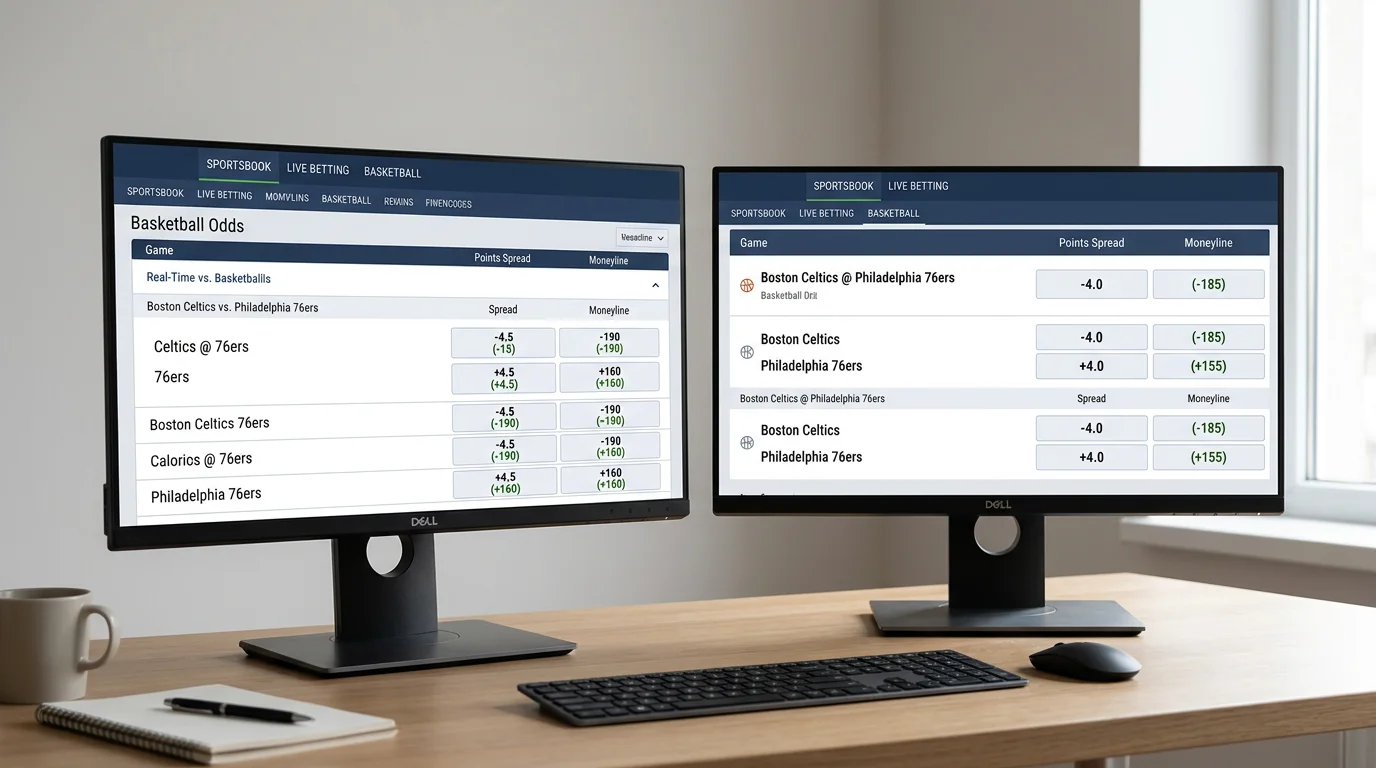
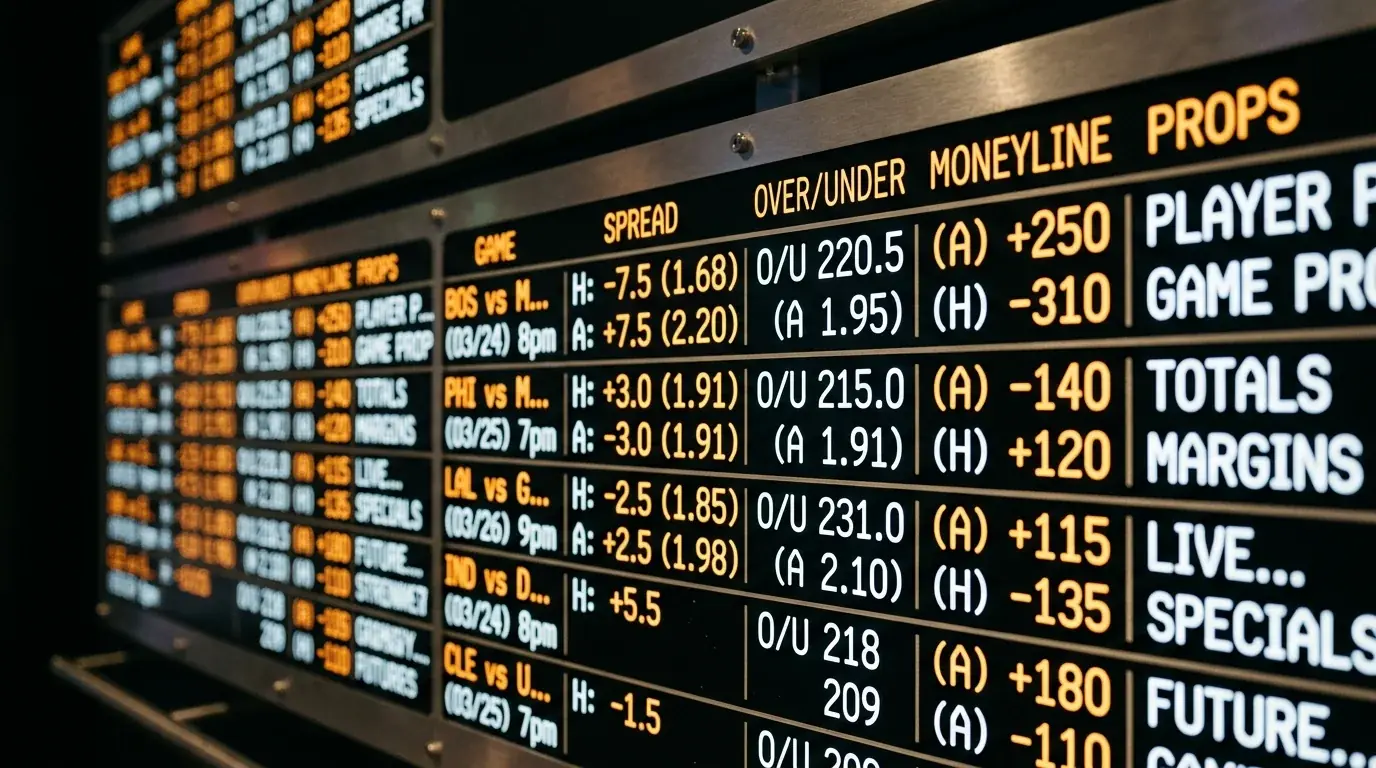
A typical NBA odds board at a UK sportsbook displays each game as a row. The away team is usually listed first, the home team second. For each game, you see three primary markets: moneyline (who wins outright), spread (by how many points), and total (combined score over/under). Fractional odds appear next to each selection by default, though decimal or American displays are a settings toggle away.
Explore the full range of NBA betting markets available to UK punters.
Here is what a line might look like for a standard NBA game. Golden State Warriors: moneyline 5/4, spread +3.5 at 10/11, total Over 228.5 at 10/11. Los Angeles Lakers: moneyline 4/6, spread -3.5 at 10/11, total Under 228.5 at 10/11. The Lakers are 3.5-point favourites (negative spread), the expected combined score is around 228-229 points, and the moneyline prices reflect the Lakers’ higher implied probability of winning. Basketball sits within a global betting market where the sport provides 15-18% of all bookmaker activity — and the NBA, generating roughly 60% of basketball betting revenue worldwide, is the most liquid basketball market available.
When scanning an odds board, I look for three things in rapid succession. First, the spread number — this is the market’s consensus on the expected margin. Second, the total — this tells me whether the market expects a fast-paced or grinding game. Third, the moneyline prices relative to the spread — sometimes the moneyline offers better implied value than the spread for a moderate favourite, and vice versa. The approximately 290 million online bets placed monthly across the UK market are priced using these same mechanics, whether the sport is football, horse racing, or basketball.
One detail that catches new NBA bettors: the half-point on spreads and totals (3.5, 228.5) exists to eliminate ties. There is no push at a half-point number — your bet wins or loses. When a spread sits at a whole number like -4, a push is possible if the favourite wins by exactly 4 points. Understanding this distinction matters when choosing between alternative lines — paying a slightly worse price to move from -4 to -3.5 can be worth the insurance against a push, depending on how frequently games land on that specific margin.
Frequently Asked Questions
Why do different UK sportsbooks show different NBA odds?
Each sportsbook sets its own margin and risk management strategy. Some platforms run tighter margins on NBA spreads to attract basketball bettors, while others pad their NBA odds because basketball is a secondary sport for them. Opening accounts at multiple sportsbooks and comparing prices before each bet lets you consistently take the best available odds.
How do I calculate my potential return from fractional NBA odds?
Divide the first number by the second and multiply by your stake to get your profit. Then add your stake back for the total return. At 5/2, a 10-pound bet returns 35 pounds total — 25 pounds profit plus 10 pounds stake. At 10/11, a 22-pound bet returns 42 pounds total — 20 pounds profit plus 22 pounds stake.
What is overround and how does it affect NBA betting value?
Overround is the sportsbook’s built-in margin. It is the amount by which the implied probabilities of all outcomes in a market exceed 100%. A lower overround means better value for the bettor. On NBA spreads, a tight sportsbook might run a 2-3% overround, while a wider book runs 5-6%. Over hundreds of bets, that difference significantly impacts your returns.
Do NBA odds change after I place my bet?
Your bet is locked at the price you accepted when you placed it. If the odds move after your bet, it does not affect your potential return. However, if you use a cash-out feature during the game, the cash-out value will reflect the current odds, not your original price. Pre-game odds typically move as new information (injuries, lineup changes) becomes available and as betting volume shifts.
Created by the ”nba Betting Online” editorial team.